
AI-Native Scale
Six levels between using AI and operating with AI.
The AI-Native Scale is a six-level maturity model (0 to 5) that places a company according to how much of its operation runs on artificial intelligence. It separates the company that uses AI tools from the one that has redesigned its operating model around them.
Six levels. One next step at a time.
Select a level to see what changes in the operation and where to focus the next effort.
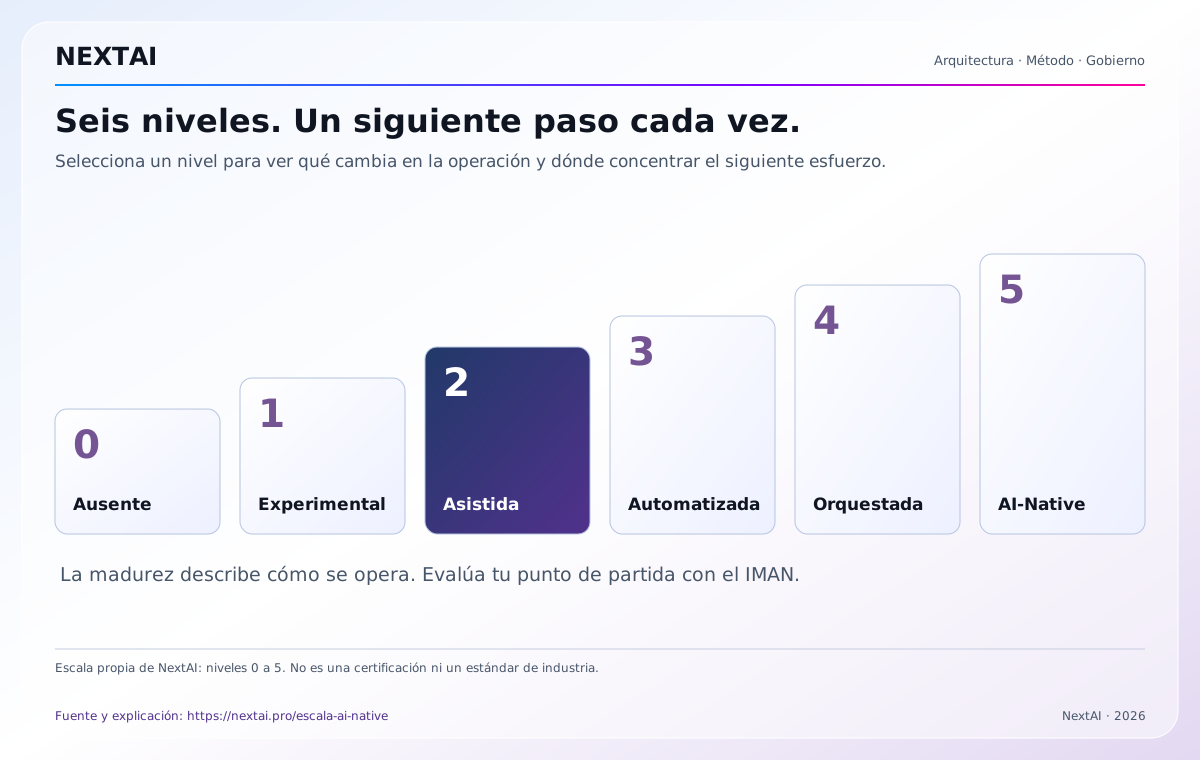
NextAI's own scale: levels 0 to 5. It is not an accreditation or an industry standard.
The levels
Anecdotal, personal use. No process depends on AI.
Isolated pilots that never reach production. Pilot fatigue.
Copilots in use. People still execute everything.
Task agents in production with metrics of their own.
Superagents on an Enterprise Brain, with formal governance.
The operating model is designed assuming agents do the executing.
What placing yourself at a level is for
( Diagnosis before architecture )The AI-Native Scale does not describe technology installed: it describes how much of a company's work runs on artificial intelligence. That is why it separates the company that uses AI from the one that has redesigned its operation around it.
Why a scale is needed
Almost every company answers the same way when asked about its use of artificial intelligence: «we're doing something». That answer supports no decision. A scale forces you to describe the real state — what runs on its own and what does not — instead of the intention.
What problem it solves
It orders the investment. Each level has a single sensible next step, so the budget stops being split across five initiatives that never reach production and concentrates on the one that opens up the next jump.
How it differs from a digitalisation plan
A digitalisation plan measures systems installed. The Scale measures execution: how many processes finish without human intervention. You can have your whole stack renewed and sit at level 1, and you can be at level 4 on a ten-year-old ERP.
A level is not declared, it is demonstrated
The level is evidenced by RAO measured per process. A company with four AI tools and no autonomous process is at level 1, whatever its slide deck says.
It does not depend on size
The scale describes processes, not headcount. A twenty-person company can reach level 4 in invoicing before a five-hundred-person one, because it has fewer legacy systems and fewer approval layers.
Symptom, autonomy and next step
( From 0 to 5 )Each level is recognisable by a symptom anyone in the company can identify without a report, has an expected autonomy range and a single next step that opens up the jump.
| Level | What happens | Recognisable symptom | Typical RAO | Next step |
|---|---|---|---|---|
| 0 · Absent | AI touches no process at all | «We don't use that here yet» | 0% | Inventory processes and data sources; pick a candidate process |
| 1 · Experimental | Isolated pilots that never reach production | Personal accounts, uneven results, zero traceability | 0–5% | Define a usage policy and connect AI to real company data |
| 2 · Assisted | Copilots in use; people still do the executing | AI writes the draft and someone rewrites it | 5–25% | Build the Enterprise Brain: queryable memory and permissions |
| 3 · Automated | Task agents in production with metrics of their own | Answers are correct and citable, but someone still closes the case | 25–50% | Deploy the first superagent with a human owner and a target RAO |
| 4 · Orchestrated | Superagents on the Brain, with formal governance | The team reviews exceptions, not runs | 50–80% | Coordinate several agents, register the identity and limits of each |
| 5 · AI-Native | The operating model is designed assuming agents do the executing | New processes are born with an agent assigned | > 80% on core processes | Continuous improvement, audit and new lines of work |
The RAO ranges are the references NextAI uses to validate the level claimed in a project, based on our implementation experience. They are not an industry standard.
From level 2 to 3: the one thing you cannot buy
( Everything is decided here )There is one stretch of the scale that no tool purchase can solve, and it is the one that decides whether the rest of the programme works.
From 0 to 2 you move by buying
Tools, licences and training. This is the stretch the market knows how to sell and the one almost every company has already covered, sometimes without noticing.
From 2 to 3 you have to build
No licence helps here: what is needed is the company's memory. Contracts, price lists, precedents and internal criteria in a queryable layer, with permissions by role.
Why this is the jump most often missed
Because it produces no impressive demo. It is weeks of connecting sources and structuring meaning with no new agent to show the board, and it is exactly what holds everything else up.
What happens if you skip it
You deploy agents without context, which are confidently wrong and force a review of every run. That is the operational definition of pilot fatigue and the origin of Context Debt.
A company moving from level 2 to level 4
( Twenty weeks, one process )Seeing the whole journey in a worked example helps explain why the level rises process by process rather than department by department, and why the slowest stretch is also the most profitable.
The figures in this section are a worked assumption used to explain the calculation. They are not a market figure or the result of a specific client.
An industrial distributor of 60 people with ERP and CRM in use and orders arriving by email.
Level 2: several people use copilots to draft; no process finishes on its own.
Two: answering lead-time and stock queries, and preparing standard quotes.
Around twenty weeks to level 4 on the first process.
| Stretch | What is done | Level at the end | RAO of the pilot process |
|---|---|---|---|
| Weeks 1–3 | Inventory of processes and sources; IMAN diagnosis; choice of the two processes | 2 | 8% |
| Weeks 4–9 | Corporate memory: price lists, terms, order history and permissions by role | 3 | 22% |
| Weeks 10–15 | First superagent in production with narrow thresholds and declared escalation | 3 → 4 | 47% |
| Weeks 16–20 | More cases covered, agent registry and sample-based supervision | 4 | 68% |
The invisible stretch is the decisive one
Between weeks 4 and 9 no agent goes into production and RAO barely moves. It is the stretch that makes the next one rise twenty-five points.
The level rises process by process
By week 20 the company is at level 4 on lead-time queries and still at level 2 on quotes. Claiming «we are level 4» without saying on which process means nothing.
Governance is not the last phase
Authority limits and the agent's registry entry are written before it is switched on, not once the process already runs by itself.
What gets decided at the end
With one process at level 4 and its RAO stable, the next process reuses the same memory: the second run is always shorter than the first.
An example built to illustrate the sequence. Timelines depend on how scattered the data is and on the availability of the company's team.
What the AI-Native Scale is not
( Five misunderstandings )The scale is misused when it becomes a label for communications instead of a tool for deciding where the next euro goes.
It is not a league table
It is not for comparing sectors or for boasting in a press release. It is for knowing what to work on next inside one specific company.
It is not a scale of tools
Adding licences does not raise the level. Giving access to half the staff is the literal definition of level 1: more people using AI with no company context.
You cannot skip level 3
You can deploy an agent without corporate memory; what you cannot do is sustain it. Without context, the agent asks for help on almost every run.
It is not declared without measuring
A level without RAO per process is an opinion. It is the most common mistake and the most expensive, because it justifies investment in the wrong stretch.
You do not move up on every process at once
Splitting the budget across five processes guarantees none of them reaches production. You move up process by process.
How it connects to the rest of the system
( Diagnosis, method and evidence )The Scale places you, IMAN scores you, the NEXT-5 Roadmap takes you there and RAO proves it. Four pieces of the same system, and none works alone.
Frequently asked questions about the Scale
( What the board asks )Which level is my company at if we use generative AI every day?
Level 1, unless those tools are connected to company data. Level 1 is defined exactly like that: people using loose AI, with uneven results and no traceability. It is a useful starting point, but it generates no measurable autonomy.
Can you jump straight to level 4?
Technically you can deploy an agent without corporate memory; what you cannot do is sustain it. Without level 3 the agent lacks the context to decide well and ends up needing human review almost every time. The profitable path is 2 → 3 → 4.
How long does it take to move up a level?
In our project experience, moving from level 2 to 3 takes four to eight weeks, and from 3 to 4 between six and twelve weeks per process. Level 5 is not measured in weeks: it means redesigning the whole operating model.
Are the AI-Native Scale and IMAN the same thing?
They are complementary. The Scale describes the stage qualitatively across six levels; IMAN gives a score from 0 to 100 across five axes that lets you compare the same company over time. Each IMAN range corresponds to a level of the Scale.
What if different processes are at different levels?
That is normal and not a problem. A company's level is read across its core processes, and the useful conversation is which one moves up first. Declaring a global level without saying which processes you mean adds no information.
How does AI-Native Scale apply to your company?
Tell us how your operation works today and we will tell you what can be built and where to start.
Book your Digital AuditReady to apply this to your business?
Eva helps you choose. Our team scopes your project.