The vocabulary of AI that executes
52 definitions for talking about enterprise artificial intelligence precisely: what corporate memory is, what separates an agent from a chatbot, how autonomy is measured and what AI governance requires before anything is switched on.
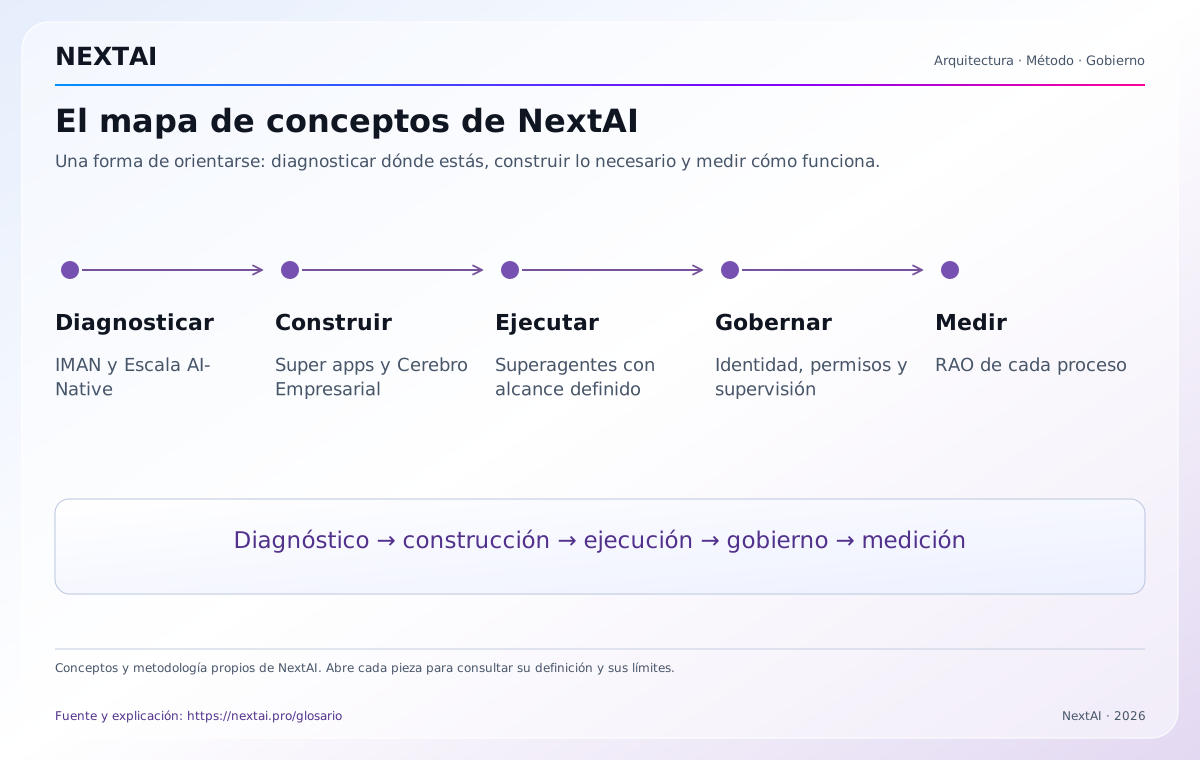
The NextAI map of concepts
A way to get your bearings: diagnose where you are, build what is needed and measure how it works.
Concepts and methodology developed by NextAI. Open each piece for its definition and its limits.
Six concepts with a page of their own. They are the framework we use to diagnose, build and measure every project.
Enterprise Brain
An Enterprise Brain is the multi-layer architecture on which an entire company is run with artificial intelligence: data, memory, reasoning, agents that execute, a voice desk that answers and governance that accounts for every action. It is not a chatbot, it is not a data warehouse and it is not a layer bolted onto your stack: it is the system that ends up taking over what your ERP, your CRM, your helpdesk, your BI and your automation tools do today.
Superagent
A Superagent is an AI agent that takes ownership of a business process end to end: it receives the trigger, queries the Enterprise Brain, executes the actions in your systems and escalates to a person only on exceptions. It is measured by its Operational Autonomy Ratio, not by how many messages it answers.
AI-Native Scale
The AI-Native Scale is a six-level maturity model (0 to 5) that places a company according to how much of its operation runs on artificial intelligence. It separates the company that uses AI tools from the one that has redesigned its operating model around them.
NEXT-5 Roadmap
The NEXT-5 Roadmap is the NextAI implementation method: five phases with deliverables, owners and metrics that take a company from diagnosis to operating with superagents in production, without getting stuck in pilots.
RAO
RAO (Operational Autonomy Ratio) measures what percentage of a process runs end to end with no human intervention. It replaces vanity metrics — queries, active users, messages — with the only question that matters: how much work gets done on its own.
IMAN
IMAN is the NextAI AI-Native Maturity Index: it scores a company's artificial intelligence maturity from 0 to 100 across five axes — Data, Memory, Reasoning, Agency and Governance — and places it at a level of the AI-Native Scale with a concrete next step.
Maturity and measurement
( 8 terms )Before building anything you need to know where the company stands. These are the concepts we use to measure maturity, autonomy and real progress.
- IMAN (AI-Native Maturity Index)
- NextAI's own index, scoring a company's artificial intelligence maturity from 0 to 100 across five axes — Data, Memory, Reasoning, Agency and Governance — placing it at a level of the AI-Native Scale and returning a concrete next step. It does not measure enthusiasm or the number of tools bought: it measures whether the organisation has the substrate an agent needs to do real work. Read more ↗
- IMAN axes
- Data (which sources exist, at what quality and under which permissions), Memory (whether the company's context is kept in a queryable form), Reasoning (whether AI takes part in decisions or only drafts text), Agency (how much work runs without human intervention) and Governance (registry, limits, audit trail and compliance). A high IMAN on Data and a low one on Governance predicts a project that stalls before production; the reverse predicts pilots that never scale. Read more ↗
- IMAN band
- The score range that turns the index into a diagnosis: 0-20 absent, 21-40 experimental, 41-60 assisted, 61-80 automated, 81-100 orchestrated or AI-Native. The band determines what can be built now and what would be premature to touch. Read more ↗
- RAO (Operational Autonomy Ratio)
- The percentage of runs of a process that complete end to end with no human intervention. It is calculated per process, not per company, and replaces vanity metrics (queries, active users, messages sent) with the only question that matters: how much work gets done on its own. Read more ↗
- Context Debt
- The accumulated, invisible cost of artificial intelligence — and often people too — not knowing the real context of the company. It is paid in repeated analysis, decisions made without information that already existed and generic answers to specific problems. It is the debt an Enterprise Brain pays down. Read more ↗
- Pilot fatigue
- The organisational condition of piling up AI proofs of concept that never reach production — what is often called “pilotitis”. The classic symptom of level 1 on the AI-Native Scale: plenty of activity, zero RAO. Read more ↗
- AI-Native Scale
- A six-level maturity model (0 to 5) that separates the company using AI tools from the one that has redesigned its operating model assuming agents do the executing. Read more ↗
- NEXT-5 Roadmap
- A five-phase implementation method — Level, Structure, Xtend, Transfer, Scale — with deliverables, owners and metrics in each. Designed so that no phase obliges you to sign up for the next one. Read more ↗
Enterprise brain and data
( 10 terms )The layer that makes AI know your business. This is where the technical concepts behind corporate memory live.
- Enterprise Brain
- A company's memory and reasoning layer: it brings documents, data, decisions and processes together in an architecture that AI can query with real context. It is not a chatbot, not a data warehouse and not a subscription to a model. Read more ↗
- RAG (Retrieval-Augmented Generation)
- A technique that, before answering, retrieves the relevant fragments of the company's documentation and injects them into the model's context. It is the basic query mechanism of an Enterprise Brain: it turns a generic answer into an answer with sources. Read more ↗
- Embedding
- A numerical representation of a text that allows searching by meaning rather than by exact words. Two sentences that say the same thing with different vocabulary end up close together in that space, and that is what lets the brain find the right policy even when nobody named it the same way.
- Vector database
- A store optimised for searching embeddings by similarity. It is the shelf where the Enterprise Brain keeps what it knows so it can retrieve it in milliseconds.
- Chunking
- Splitting documents into fragments that make sense on their own before indexing them. Poor chunking cuts a clause in two and produces incomplete answers: it is one of the most frequent causes of a brain that “gets things wrong”.
- Knowledge graph
- A model that represents the company's entities (customer, project, invoice, supplier) and the relationships between them. It complements semantic search when the question is not “what does this document say?” but “what connects to what?”. Read more ↗
- Ground truth
- The single, verified version of a piece of data inside the organisation. Without ground truth, two departments argue with two correct figures and no decision moves forward.
- Hallucination
- A plausible but false answer from a generative model. It drops sharply when the model answers on the basis of sources retrieved from the brain and is required to cite where each statement comes from.
- Context window
- How much information a model can hold in a single operation. It is finite, which is why the real work is not “putting everything in” but retrieving what is relevant.
- Connector
- An integration that brings into the brain whatever lives in an existing system — ERP, CRM, email, document storage, e-signature, invoicing — respecting its source permissions. Read more ↗
Agents and automation
( 9 terms )From answering to executing. These terms mark out what a real agent is and what is an automation with good marketing.
- Superagent
- An AI agent that takes ownership of a business process end to end: it receives the trigger, queries the brain, executes actions in the systems and escalates to a person only on exceptions. It is measured by RAO, not by conversations. Read more ↗
- Chatbot, copilot, agent
- Three different things. A chatbot answers; a copilot suggests inside a tool while the person still executes; an agent executes and answers for a result. Confusing the three explains most disappointments with AI. Read more ↗
- Tool use
- An agent's ability to call real functions — create an invoice, move an opportunity, send a delivery note — instead of describing what ought to be done. Without tool use there is no agency, only text. Read more ↗
- Human-in-the-loop
- A design in which the person does not supervise every step but steps in where their judgement adds value: exceptions, high amounts, ambiguous cases. Read more ↗
- Escalation
- The orderly hand-over of a case from the agent to a person, with the full context of what has already been done. A well-built escalation is the difference between an agent you can rely on and one you have to watch. Read more ↗
- Orchestration
- Coordinating several agents, systems and people over the same process, with shared state and priority rules. It is what separates level 3 from level 4 of the AI-Native Scale. Read more ↗
- Idempotency
- The property that running the same action twice does not double the effect. In agents that issue payments, orders or emails it is a design requirement, not a technical detail.
- Traceability
- A record of what the agent did, with what information and under what authority. It is the basis of internal audit and regulatory compliance.
Super apps and product
( 7 terms )The custom software where the operation lives: screens, roles, data and agents in the same place.
- Super app
- A custom business application that brings the data, the screens, the roles, the automations and the agents of a process or a whole area together in one product. It replaces the sum of spreadsheets, forms and generic tools with a system of your own. Read more ↗
- System of record
- The application where a piece of data is born and is treated as true. Defining it avoids the classic scenario of three different places holding three versions of the same customer. Read more ↗
- Data model
- The definition of the business entities and their relationships inside the app. It is the most decisive choice in a project: a well-designed model carries ten years of change, a bad one forces a rebuild. Read more ↗
- Permissions by role
- The rules that determine what each user profile sees and can change. In projects with external clients or several companies, it is the requirement that decides whether the app can go to production. Read more ↗
- Customer portal
- The area of the app where the end customer checks their file, uploads documents and follows the status of their service. It cuts email and phone traffic more than any other feature. Read more ↗
- Time-to-value
- The time from kick-off until the software produces a measurable benefit. It is the metric that forces us to deliver the first useful version in weeks rather than quarters.
- Agentic interface
- A screen designed on the assumption that part of the work is done by an agent: it shows what has already been settled on its own, what is awaiting approval and what needs human judgement. Read more ↗
Governance, risk and compliance
( 7 terms )Without this layer an AI project does not reach production in a serious company. With it, it stands up to the board, the client and the auditor.
- AI governance
- The set of policies, roles and records that determine how an artificial intelligence system is approved, deployed, monitored and retired in an organisation.
- Digital ID for AI agents
- A cryptographically signed credential that identifies a software agent and states which company answers for it, what it is allowed and forbidden to do. It expires, it can be revoked and anyone can check it in seconds from a public page, with no sign-up. Read more ↗
- EU AI Act
- The European artificial intelligence regulation that classifies systems by risk level and imposes obligations on transparency, human oversight, documentation and risk management. It determines what can be automated and under which controls.
- Risk classification
- The exercise of placing each use case in its category (minimal, limited, high or prohibited risk) to know which controls are mandatory before switching anything on.
- Data minimisation
- The principle of processing only the data strictly necessary for the stated purpose. Applied to AI, it means the agent reaches what it needs for its process and not the company's entire archive.
- Audit log
- An immutable history of automated actions: what was done, when, with what data and under what authority. It is the first thing an audit asks for and the last thing that usually exists.
- Effective human oversight
- The requirement that a person with real competence and authority can understand, correct and stop the automated decision. It is not met with a pause button nobody knows how to use.
Visibility in the age of AI
( 5 terms )How a company gets found today: less and less in a list of links, more and more inside a generated answer.
- GEO (Generative Engine Optimization)
- The discipline of getting generative engines — assistants and AI search — to cite and recommend a company. It depends less on keywords and more on there being clear, structured, attributable content about what the company does.
- Entity (semantic SEO)
- A concept an engine recognises as a thing with a name of its own — a company, a method, a metric — and about which it accumulates attributes. Building your own entities, with a page and a stable definition, is what turns vocabulary into authority. Read more ↗
- Structured data (schema.org)
- Markup that states in machine-readable form what each page is: an organisation, a service, a definition, a set of frequently asked questions. It is the difference between hoping the engine understands and telling it.
- llms.txt
- A public file at the root of a site that summarises in plain text what it contains and what should be consulted, written for language models. It complements the traditional sitemap.
- Content cluster
- A set of articles surrounding a pillar page and linking to each other. It is the structure that takes a topic from a passing mention to recognisable territory. Read more ↗

Which band is your company in?
The glossary explains the vocabulary. The IMAN self-assessment tells you where you stand: a score across the five axes and a concrete next step.
Ready to apply this to your business?
Eva helps you choose. Our team scopes your project.