
Enterprise Brain
Your company's operating system. It does not just remember: it operates.
An Enterprise Brain is the multi-layer architecture on which an entire company is run with artificial intelligence: data, memory, reasoning, agents that execute, a voice desk that answers and governance that accounts for every action. It is not a chatbot, it is not a data warehouse and it is not a layer bolted onto your stack: it is the system that ends up taking over what your ERP, your CRM, your helpdesk, your BI and your automation tools do today.
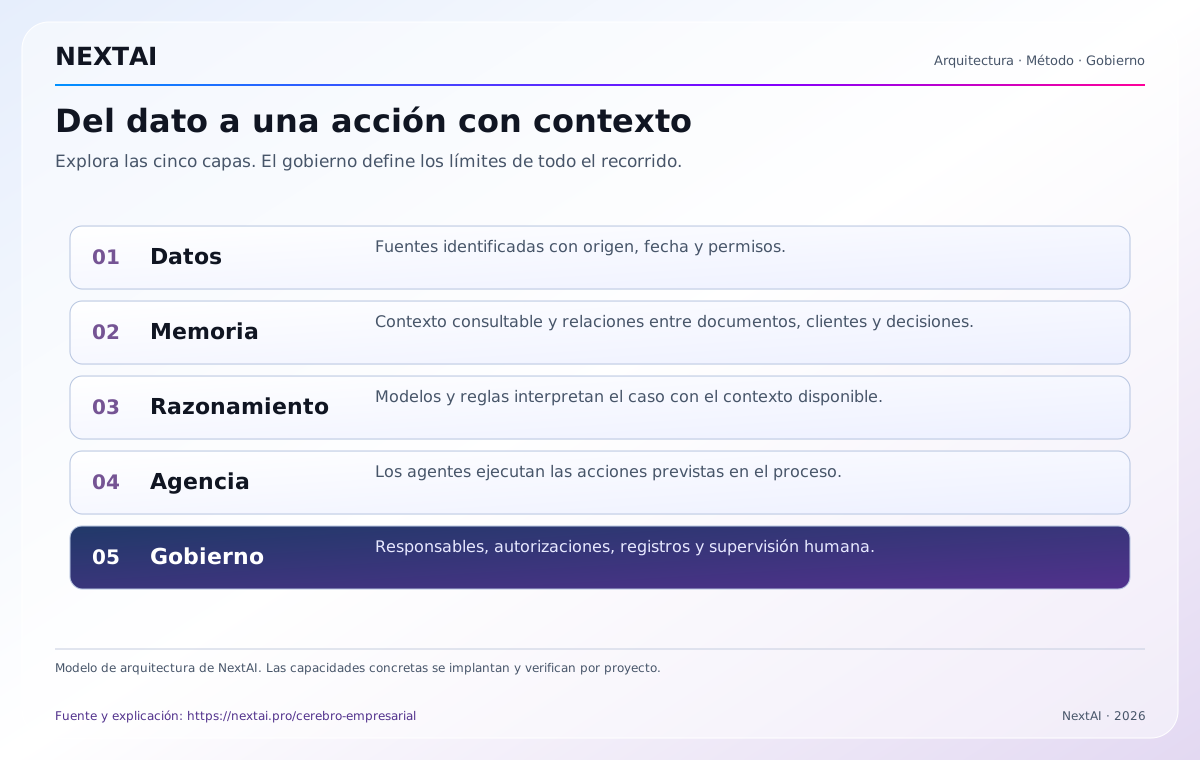
From data to an action with context
Explore the five layers. Governance sets the limits across the whole journey.
Data
Sources identified with origin, date and permissions.
NextAI architecture model. Specific capabilities are implemented and verified project by project.
What it solves
Removes the invisible cost of an AI that does not know your business and answers in generic terms.
One single version of the truth instead of ten tools each holding a different fragment.
One system instead of ERP, CRM, voice desk, helpdesk, BI and automations held together with tape.
The company stops deciding without knowing what it already knows.
The five layers of an Enterprise Brain
( From source to governance )It is not a product you install: it is an architecture built layer by layer that, one layer at a time, takes over the work half a dozen separate systems share out today. Each layer answers one question and none of them works alone.
We start by connecting the live sources — ERP, CRM, email, documents, spreadsheets, customer channels — without switching anything off. Later the real record moves here and those systems remain as historical sources. Nothing is copied blind: everything is indexed with its origin, its date and its permission.
A vector store for meaning and a knowledge graph for relationships: which customer belongs to which group, which contract depends on which annex, which decision overrode which other. Every answer can cite its source.
A layer of models and rules decides what context is needed, at what precision and with which model the answer is produced. Trivial cases are settled cheaply; critical ones escalate to a higher-capability model with verification.
Superagents act on that memory: they open, move and close complete processes, staff the voice desk and the customer channels, and replace the automations that used to break on the first exception. A Brain without agency is a library; agency without a Brain is an intern with no context.
An agent registry, authority limits by amount and criticality, human approval at defined points and a full audit trail of every action. Without this layer there is no production, only an experiment.
It does not plug in. It replaces.
( Layer by layer )During the transition we integrate with what you already have, because nobody switches their company off on a Monday. But the destination is not a stack with AI on top: it is an architecture where your systems stop being systems and become, at most, data sources. This is what each layer takes over.
Data and memory layer
The ERP and the CRM stop being the system where work happens and become, at most, a source during the transition. The real record of customers, operations, contracts and decisions lives in the brain's memory, which does understand what it holds.
A single queryable memory, with origin, date and permission on every piece of data
Communication layer
The voice desk and the ticket queue exist because conversations have to be shared out among people. When the one answering is an agent that already knows the customer, their history and their contracts, the queue disappears: there is nothing left to share out.
Voice, email and customer channels handled by agents with full context
Execution layer
An automation only knows how to repeat the expected path and breaks on the first exception. A superagent reasons about the specific case, decides, executes in whichever system applies and escalates to a person only when the exception warrants it.
Superagents that own the complete process, with declared authority
Analysis and governance layer
BI exists so that someone looks at a dashboard and draws a conclusion. Here the conclusion arrives written, with the source identified, and in many cases with the action already taken and recorded. The dashboard stops being the product.
Answers with the source cited and an audit trail of every action executed
What happens from the moment someone asks
( Six steps, always the same )This is the circuit that separates a useful answer from a plausible one. It happens in seconds and leaves a complete trace.
A question, an email, a form or a system event arrives.
The Brain searches semantic memory and the graph for the exact context that applies.
Anything the person asking has no right to see is discarded.
The answer or the action is decided, with the source identified.
A Superagent writes to the relevant system and documents it.
A trace remains: what was queried, what was decided and under what authority.
AI answers in generic terms, the team rewrites the result and mistrust kills adoption.
AI answers with the reality of the house, the answer is used as it comes and adoption holds.
What a Brain does and the alternatives do not
( Four different things )They get mixed up daily because all four answer questions. Only one knows your company, remembers its decisions and acts on its systems.
| Capability | Chatbot | Stand-alone LLM | Data warehouse | Enterprise Brain |
|---|---|---|---|---|
| Knows your business | No | Partly | Figures only | Yes |
| Remembers decisions | No | No | No | Yes |
| Cites the source | No | Sometimes | Yes | Yes |
| Executes in your systems | No | No | No | Yes |
| Permissions per person | No | No | Yes | Yes |
| Audit trail of actions | No | No | Partly | Yes |
| Improves with use | No | No | No | Yes |
It connects to what you already have
( No stack migration )The Brain does not replace your tools: it reads them and writes to them. More than 32 common connection points, grouped by the work they do, with the typical flow each one enables.
CRM and sales
01The pipeline stops living in the sales rep's head.
Reads accounts, opportunities and activity; writes notes, stages and tasks.
Qualifies the incoming lead and updates properties and deals with no manual work.
Syncs contacts and enriches the record with context from email and meetings.
Adds market signal and firmographics to the account profile.
ERP, finance and payments
02The admin cycle closes on its own, or stops with a reason.
Reconciles movements, spots discrepancies and prepares the entry.
Payments, subscriptions, failed charges and automatic recovery.
Issues and tracks invoices with validation by exception.
Reads and writes the dashboards the team already uses.
Communication and channels
03The agent works where the conversation already is.
Receives triggers, asks for validation and returns the result in the channel.
Classifies, replies with context and opens a case file when appropriate.
Answers, resolves and escalates to a person only on exceptions.
Closes tickets end to end with the customer's memory in front of it.
Documents and productivity
04This is where the knowledge nobody could ever query lives.
Indexes contracts, proposals, minutes and manuals with permissions.
Turns the internal wiki into queryable, citable memory.
Drafts the deliverable in the format and the voice of the house.
Respects the corporate document structure and its governance.
Projects and operations
05Work moves forward without anyone having to push it.
Creates, assigns and closes tasks with the real state of the process.
Turns a customer incident into a technical ticket, reproduction included.
Books, reschedules and prepares the meeting with a briefing pack.
Captures structured input and routes it to the right process.
Data and analytics
06The decision rests on the figure, not on a hunch.
Queries the corporate warehouse to reason over real volume.
Reads and writes the operational databases of the day to day.
Watches demand, visibility and traffic drops.
Detects product friction and errors before the customer does.
Marketing and visibility
07Presence is sustained without depending on one person.
Segments, drafts and sends with the customer's memory.
Watches cost per result and cuts what does not perform.
Publishes and replies in the defined brand voice.
Updates web content and product records with no bottleneck.
People and governance
08Traceability and limits before speed.
Onboarding, documentation and tracking of the employee lifecycle.
Prepares, sends and files the signature with the complete case file.
Changes, reviews and deployments with an auditable record.
Escalates the incident to the right person with the context attached.
What we build the Brain with
( The infrastructure )Digital Cortex is our implementation product: the data layer, the agents, the orchestration and the governance already solved. It is what makes it possible to deliver an Enterprise Brain in production rather than a permanent pilot.


Digital Cortex is the product infrastructure we use to build and roll out turnkey Enterprise Brains.
Data layer, agents, orchestration and governance already solved: no project starts from zero.
Subvia.es was built entirely on Cortex: its brain interprets public regulation and runs the full business cycle.
The full process, the cases and the rollout model are published at digitalcortex.tech.
How does Enterprise Brain apply to your company?
Tell us how your operation works today and we will tell you what can be built and where to start.
Book your Digital AuditBuild your service. See your estimate.
Choose what your process needs. See indicative setup and monthly costs instantly, without sharing your contact details.
Ready to apply this to your business?
Eva helps you choose. Our team scopes your project.