We do not sell three things. We build a company that runs itself.
What we build is a business operating system: a multi-layer architecture of data, memory, agents, voice and governance that takes over the whole operation. Super apps and superagents are not parallel services: they are the two doors into that system. You come in where it hurts most and the rest is built around it.
How the NextAI pieces fit together
Super apps organise the work; superagents execute it; the Enterprise Brain connects their context.
Scope and integrations are defined in each project.

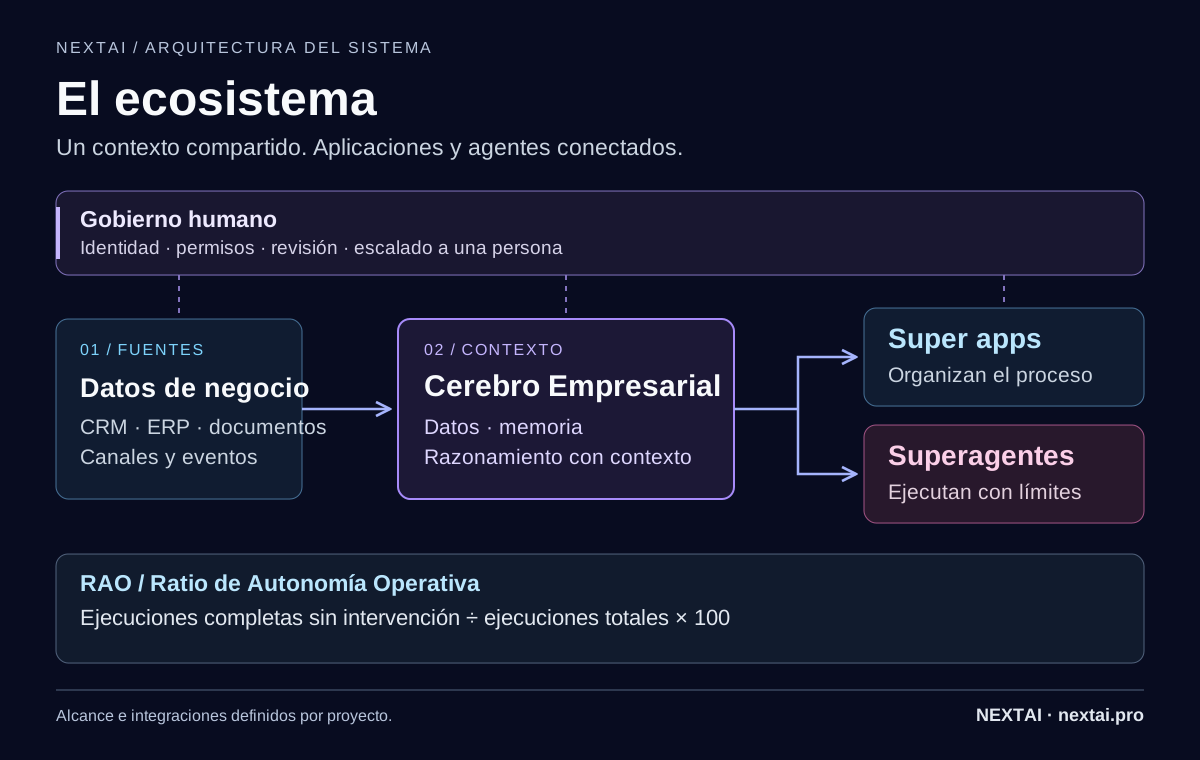
Enterprise Brain on Digital Cortex
A company run by artificial intelligence is not a company with AI bolted on: it is a multi-layer architecture where the data, the memory, the reasoning, the agents that act, the voice that answers and the governance that accounts for it form a single system. That is where super apps and superagents live. They are not alternatives to it; they are the parts it is built from.
It does not plug in. It replaces.
( Layer by layer )During the transition we integrate with what you already have, because nobody switches their company off on a Monday. But the destination is not a stack with AI on top: it is an architecture where your systems stop being systems and become, at most, data sources. This is what each layer takes over.
Data and memory layer
The ERP and the CRM stop being the system where work happens and become, at most, a source during the transition. The real record of customers, operations, contracts and decisions lives in the brain's memory, which does understand what it holds.
A single queryable memory, with origin, date and permission on every piece of data
Communication layer
The voice desk and the ticket queue exist because conversations have to be shared out among people. When the one answering is an agent that already knows the customer, their history and their contracts, the queue disappears: there is nothing left to share out.
Voice, email and customer channels handled by agents with full context
Execution layer
An automation only knows how to repeat the expected path and breaks on the first exception. A superagent reasons about the specific case, decides, executes in whichever system applies and escalates to a person only when the exception warrants it.
Superagents that own the complete process, with declared authority
Analysis and governance layer
BI exists so that someone looks at a dashboard and draws a conclusion. Here the conclusion arrives written, with the source identified, and in many cases with the action already taken and recorded. The dashboard stops being the product.
Answers with the source cited and an audit trail of every action executed
Where you come in
( Three doors, one system )Super apps
The system where your process lives.
Bespoke business applications: your real entities, screens by role, permissions, integrations with what you already use and agents working inside. This is what replaces the spreadsheets, the forms and the emails that hold the process together today.
You have an idea, a critical process with no system of its own, or standard software that forces you to work backwards.
Superagents
A complete process, without you.
Agents that take ownership of a process from start to finish: they receive the trigger, check the context, act inside your systems and escalate to a person only on the exceptions, with authority limits declared before they are switched on.
There is a repetitive process eating the hours of expensive people, and its rules can be written down.
Enterprise Brains
Your company's operating system.
The complete architecture: data, memory, reasoning, agents that act, a voice that answers and governance that accounts for it. Not a layer added on top of your stack, but the system that ends up taking over what your ERP, your CRM, your phone system and your automations do today.
Every tool holds a piece, none of them sees the whole, and decisions are taken without knowing what the company already knows.
They lean on each other, they do not compete
The super app creates the system where the process lives and produces clean data. Superagents act on top of that system. The brain connects every system so the company shares a single memory. Starting with any of the three is valid; starting with the one that hurts most is what we recommend.
If there is no system
Start with a super app: without a place for the process to live, any agent is working on sand.
If one task hurts
Start with a superagent on the most repetitive process and measure its RAO from the first month.
If nobody sees the whole
Start with the Enterprise Brain and clear the Context Debt before automating on top of incomplete information.
Assessment, method and metrics
Every project starts with an assessment and is held up by a method and a metric. These are the pieces around it.
Digital Audit
An on-screen assessment and a session with an expert: where to start and what not to touch yet.
IMAN
AI-Native maturity self-assessment across five axes, scored from 0 to 100.
NEXT-5 Roadmap
The five phases of the method, each with its deliverables and its owners.
RAO
The operational autonomy metric we use to check whether this is working.
AI-Native Scale
The six levels between using AI and operating with AI.
Digital Cortex
The infrastructure the ecosystems we build rest on.
Plans
Ways of working together and what each one includes.
Glossary
The full vocabulary, defined term by term.
Case studies
13 real cases with measurable results: multi-channel, BI, CRM, billing, SEPA, code auditing, neuroscience and enterprise brains.
Not sure which one to start with.
That is normal.
That is what the Digital Audit is for: one hour, no sales deck, and you leave with the map of what to build first.
Ready to apply this to your business?
Eva helps you choose. Our team scopes your project.