
NEXT-5 Roadmap
Five phases from the idea to the system that sustains it.
The NEXT-5 Roadmap is the NextAI implementation method: five phases with deliverables, owners and metrics that take a company from diagnosis to operating with superagents in production, without getting stuck in pilots.
The NEXT-5 Roadmap at a glance
Each phase leaves a deliverable and a decision: continue, adjust or stop.
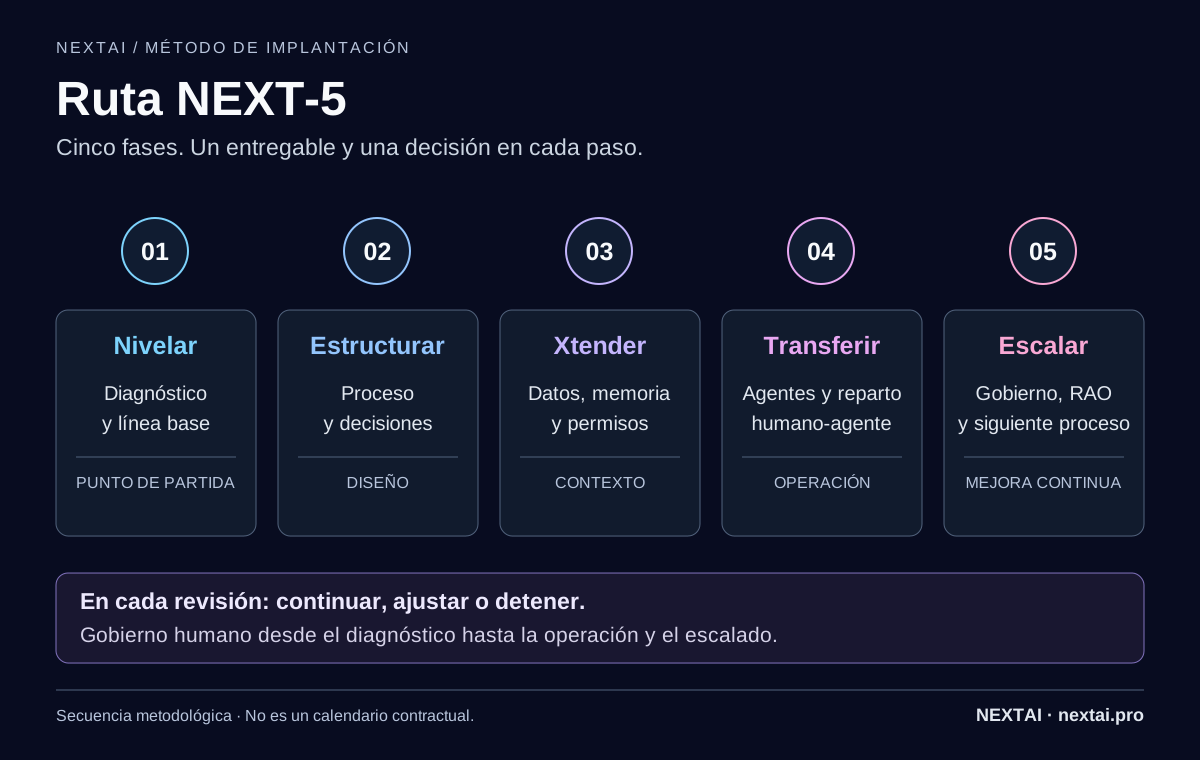
- 1
Level
Diagnosis and baseline
Deliverable and review - 2
Structure
Process and decisions designed
Deliverable and review - 3
Xtend
Data, memory and permissions
Deliverable and review - 4
Transfer
Agents and the human-agent split
Deliverable and review - 5
Scale
Governance, RAO and the next process
Deliverable and review
A methodological sequence, not a contractual schedule. Governance is designed from the start and continues throughout.
The 5 phases
IMAN diagnosis, inventory of processes and sources, autonomy baseline.
The process redesigned around the decision rather than the task.
Building the Enterprise Brain: data, memory and permissions.
Superagents into production and the human-agent split.
Governance, RAO measurement and the next process.
Why the order matters more than the tool
( A method, not a catalogue )The NEXT-5 Roadmap exists because most artificial intelligence programmes stall at the same point: the pilot that worked in the demo knows nothing about the business and nobody knows what to do next.
Why a method and not a list of tools
Most artificial intelligence programmes do not fail because of the model, but because of the order. The usual sequence — buy licences, build a pilot, discover it knows nothing about the business and drop it — repeats itself in very different companies because nobody decided what came first.
What problem it solves
It inverts the natural buying order. First you decide which processes deserve autonomy, then you build the memory the agents need, and only then do you deploy the first agent with real authority.
How it differs from a software project
A classic project delivers a tool at the end. Here every phase leaves something the company keeps even if the programme stops: the process map, the queryable memory, the documented agents and their registry.
A decision gate at every phase
At the close of each phase you decide to continue, correct or stop, against a criterion written in advance. Stopping at gate 3 with the memory built is a useful outcome; carrying on with a Brain that does not answer is the definition of pilot fatigue.
The team the company puts in
An executive sponsor, a human owner per process, someone to curate the context and a technical counterpart for integrations. In our experience, between four and eight hours a week in total during the early phases.
Deliverables, timelines and owners
( Level, Structure, Xtend, Transfer, Scale )Each phase ends with something the company keeps and a metric that lets it decide whether to continue. Phases 4 and 5 overlap: governance starts before the first agent executes anything.
| Phase | Deliverable | Indicative duration | Owner at the client | Exit metric |
|---|---|---|---|---|
| 1 · Level | Map of processes, data and decisions; IMAN diagnosis; prioritised portfolio | 2–3 weeks | Operations director | Annual hours at stake per process and starting level |
| 2 · Structure | Process redesigned around the decision, with exceptions and thresholds written down | 2–3 weeks | Process owner | Documented decisions and an agreed target RAO |
| 3 · Xtend | Enterprise Brain: queryable memory, semantic layer and permissions by role | 4–6 weeks | IT and context curator | Real questions answered with an internal source cited |
| 4 · Transfer | Superagents in production and a declared human-agent split | 6–8 weeks per process | Agent owner | Measured RAO and a stable escalation rate |
| 5 · Scale | Governance, agent registry and identity, autonomy dashboard and the next process | Ongoing | Operations and governance lead | RAO per process and quarterly review of thresholds |
Indicative durations for companies of 20 to 250 people already using an ERP and a CRM, based on our project experience. They are not a delivery commitment.
An indicative 90-day schedule
( One process through to production )This breakdown shows how the phases are distributed when there is a clear candidate process. It helps you anticipate the weeks when there will be nothing to show, and why those weeks are the decisive ones.
The figures in this section are a worked assumption used to explain the calculation. They are not a market figure or the result of a specific client.
An 80-person services company, with ERP and CRM in use and a clear candidate process.
One complete process into production; the second reuses the memory already built.
Phase 5 does not fit into ninety days: it starts early and never ends.
Between four and eight hours a week in total from the internal team.
| Stretch | Phase | What happens | What is delivered |
|---|---|---|---|
| Days 1–20 | Level | Inventory of processes, sources and decisions; IMAN diagnosis; choice of process | Prioritised portfolio with annual hours and a named owner |
| Days 21–40 | Structure | Process redesigned around the decision: exceptions, thresholds and escalation criteria | The process written down, with its target RAO and its authority limits |
| Days 41–70 | Xtend | Sources connected, queryable memory, semantic layer and permissions by role | A Brain that answers real questions citing the internal source |
| Days 71–90 | Transfer | The agent runs in shadow mode, then proposes and finally executes within thresholds | The process in production with measured RAO and declared escalation |
| From day 90 | Scale | Permanent governance, agent identity and registry, opening the next process | Autonomy dashboard and quarterly review of thresholds |
Ninety days is the compressed version
It fits when there is a clear process and the data is not scattered. An ecosystem with several coordinated agents takes between twenty and thirty weeks; it is worth saying so before starting.
Half the schedule produces no agents
The first forty days switch nothing on: they put the process and its context in order. That is the stretch almost the whole market skips, and the one that decides whether the rest works.
Autonomy rises in steps
The agent first runs in shadow mode, with no real effect; then it proposes and a person approves; finally it acts within narrow thresholds. Climbing steps too early is what loses the board's confidence.
The second process is always shorter
Memory and governance are already built. What takes forty days on the first process is usually settled in a fraction of that time on the second.
An illustrative schedule. The real breakdown depends on how scattered the data is, on how many systems are involved and on the availability of the internal team.
What the NEXT-5 Roadmap is not
( Five ways to break it )The method almost always breaks the same way: by changing the order of the phases or by closing the programme on the day the first agent goes live.
It is not a task list
It is a sequence with decision gates. Running the five phases in parallel produces five half-finished things and nothing in production.
It does not start with the agents
This is the most expensive mistake we see. An agent without corporate memory answers without knowing price lists, contracts or history, and generates manual rework and mistrust.
It does not end at go-live
Phase 5 is ongoing: agent registry, limits, audit and threshold reviews. A programme that closes on launch day degrades within months.
It is not a systems migration
You do not start by replacing the ERP or the CRM. You work on what already exists, and replacement, if it comes, is a later and orderly consequence.
It does not work without a human owner
Every process needs a person accountable for its agent. An agent with no owner is not maintained, not corrected and not retired when it is no longer needed.
What gets built in each phase
( The whole system )Each phase of the Roadmap rests on a piece of the NEXTAI system: the diagnosis places you, the Brain remembers, the superagents execute, RAO measures and governance accounts for what was done.
Frequently asked questions about the Roadmap
( Before you start )How long does the NEXT-5 Roadmap take from start to finish?
The first processes go into production between week twelve and week seventeen, and an ecosystem with several coordinated agents takes between twenty and thirty weeks. With very scattered data or no consolidated ERP, the memory phase runs longer. Phase 5 does not end: it is ongoing.
Can we start with the superagents and leave the Brain for later?
You can, and it is the most expensive mistake we see. An agent without corporate memory knows no price lists, contracts or precedents, so it asks for help on almost every run. Skipping that phase only makes sense for very closed processes that do not depend on in-house knowledge.
What happens if a phase does not go well?
You stop at the decision gate and the company keeps that phase's deliverable. The process map, the queryable memory and the agent documentation remain theirs. Stopping in time is a legitimate exit from the method, not a failure.
Do we need to change ERP or CRM?
Not to start. The Roadmap works on the systems the company already uses: they are read from and written to with full traceability. If a system later stops adding value, replacement is considered process by process and in order, never as a first step.
What is delivered at the end?
The architecture documentation, the redesigned processes, the integrations, the agents with their limits written down and the governance registry. The aim is for the company to be able to run and audit its own ecosystem without depending on whoever built it.
Who decides how far an agent can go on its own?
The company does, in writing and before switching it on. Phase 2 defines which actions are autonomous, which are executed with a notification and which require prior approval. Those thresholds are reviewed each quarter in the light of RAO and the escalation rate.
How does NEXT-5 Roadmap apply to your company?
Tell us how your operation works today and we will tell you what can be built and where to start.
Book your Digital AuditReady to apply this to your business?
Eva helps you choose. Our team scopes your project.