Plans
and pricing
Start with a base service and add the connections your process needs. The calculator gives you an instant estimate; the team confirms scope and pricing.

Digital Audit
The entry point. An X-ray of your operation and a replacement plan.
- Assessment of your current processes, data and tools
- IMAN maturity index and RAO autonomy level
- Map of which systems an Enterprise Brain can absorb
- Executive report and review session
Super App
A complete process running without constant human intervention.
- Design of the process and of the agents that run it
- Your own bespoke application, with no per-user licences
- Integration with what you use today while it is being replaced
- Go-live and initial support
Enterprise Brain
The architecture that takes over the work of your ERP, CRM and helpdesk.
- Data, memory, reasoning, agency and governance layers
- Progressive replacement of legacy systems
- New processes and departments automated phase by phase
- Human governance, traceability and permanent audit
Every project is quoted from the audit: number of processes, systems to be replaced, data volume and the level of autonomy you want to reach. If you already know what you need, write to us and we will price it directly.
Choose the scope of your next step
The three formats answer different needs. You can start with whichever fits your situation.
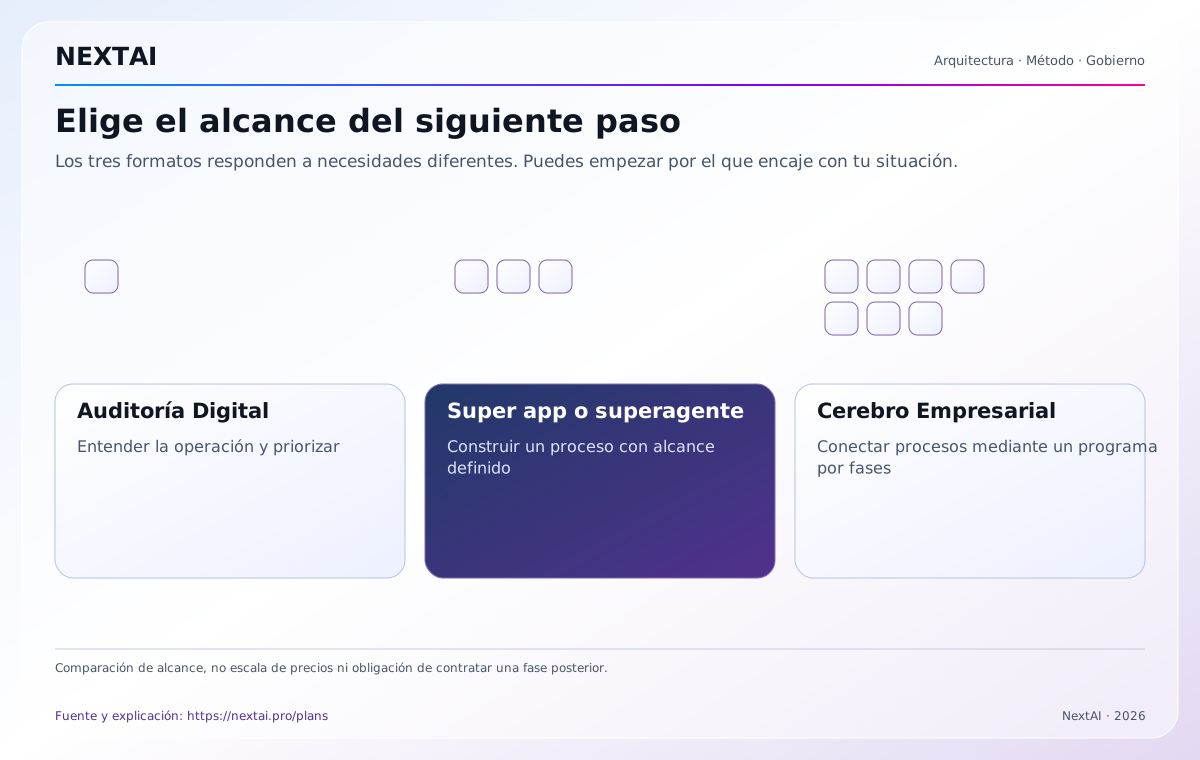
A comparison of scope, not a price ladder or an obligation to commission a later phase.
Why scope drives the price
( No per-user licences )Buying artificial intelligence by the licence forces you to justify the spend with the number of people using it. We prefer to justify it with the number of processes that no longer need a person.
Why there is no per-user price
Per-user pricing rewards having a lot of people open a tool, which is the opposite of what we are after. Here the result is a process running without anyone touching it, so scope is defined by processes and systems, not by licences.
What determines the budget
Four variables: how many processes are in scope, how many systems have to be read and written to, how much historical context needs loading and what level of autonomy you want to reach. All four come out of the audit, not out of a twenty-minute call.
Why it always starts with the assessment
Without knowing how many hours are at stake in each process you cannot decide which one deserves an agent. Quoting before that forces you to inflate the scope just in case, and the client ends up paying for that margin.
What the company keeps
The architecture documentation, the redesigned processes, the integrations and the agent registry with its limits. The aim is for the company to be able to run and audit its own system without depending on whoever built it.
Which format fits which situation
( Three entry points )The three formats answer different problems. Picking the wrong one rarely ends in a bad project: it ends in a project that solves something that was not hurting.
| Format | When it makes sense | What is delivered | How it is measured |
|---|---|---|---|
| Digital Audit | It is not clear which process should go first or how much is at stake | Map of processes and sources, IMAN assessment and a prioritised portfolio with its next step | Annual hours identified per process and the starting level |
| Super app or Superagent | There is a specific process that eats hours and has rules you can verify | The process running in production, with its authority thresholds and its escalation path declared | RAO of the process, accuracy and escalation rate |
| Enterprise Brain | The problem is not one process: it is that the information sits in ten different places | Governed corporate memory and processes moving into the system phase by phase | RAO per process and systems that are no longer needed |
Four ways to overspend
( Before you sign )The cost overruns we see almost never come from the technology: they come from deciding the scope before having the data that makes the decision possible.
Buying five processes at once
Splitting the budget across several fronts guarantees that none of them reaches production. One process closed end to end pays off more than five half-finished.
Quoting without an assessment
A scope fixed without knowing the volume or the exceptions gets corrected halfway through the project, and that correction always costs more than the initial assessment.
Forgetting the running cost
Models, infrastructure and context maintenance carry a monthly cost. It belongs in the same table as the initial investment from day one.
Judging the project by the delivery
Delivery is not the end: a process counts as finished when its autonomy holds for several months without degrading.
What to look at before asking for a quote
( The whole system )Every format rests on the same pieces: an assessment that places you, a method that orders the work and a metric that shows whether what you bought is working.
Frequently asked questions about contracting
( Before you decide )Can we start with a single process?
That is what we recommend. A process with high volume, verifiable rules and reversible errors lets you show the result in weeks and fund the next one with what it frees up. Opening five fronts at once is the most common reason none of them reaches production.
What running cost is there afterwards?
The cost of models and infrastructure per execution, plus context maintenance: new rates, process changes and cases that used to escalate and are now worth covering. It is budgeted separately from the build and reviewed alongside the autonomy dashboard.
Is there a lock-in or supplier dependency?
We do not look for one. The company keeps the architecture, the integrations, the documented processes and the agent registry. If it decides to carry on with another team, it has everything it needs to do so without redoing the work.
What if the assessment says it is not worth it?
Then we say so. If the audit does not surface enough hours at stake, or the data is too scattered to sustain an agent, the honest answer is to reduce the scope or wait. A programme that starts without substance ends up as an abandoned pilot.
Are there public support schemes that cover part of it?
There are programmes supporting digitalisation and AI advisory work for SMEs, with requirements and deadlines that change with every call. It is worth checking the conditions in force before counting on them in the budget.
Start with the audit
€290 and a full X-ray of your operation: what gets automated, which systems disappear and in what order.
Request a Digital AuditBuild your service. See your estimate.
Choose what your process needs. See indicative setup and monthly costs instantly, without sharing your contact details.
Ready to apply this to your business?
Eva helps you choose. Our team scopes your project.