Your process does not fit inside off-the-shelf software
You have an idea, a business problem or a process that today survives in spreadsheets and emails. We build the application that holds it up: your own data, screens by role, integrations with what you already use and AI agents working inside.
Inside a super app
A process of your own brings the information, the people and the actions together in one place.
Modules and permissions depend on the process being built.

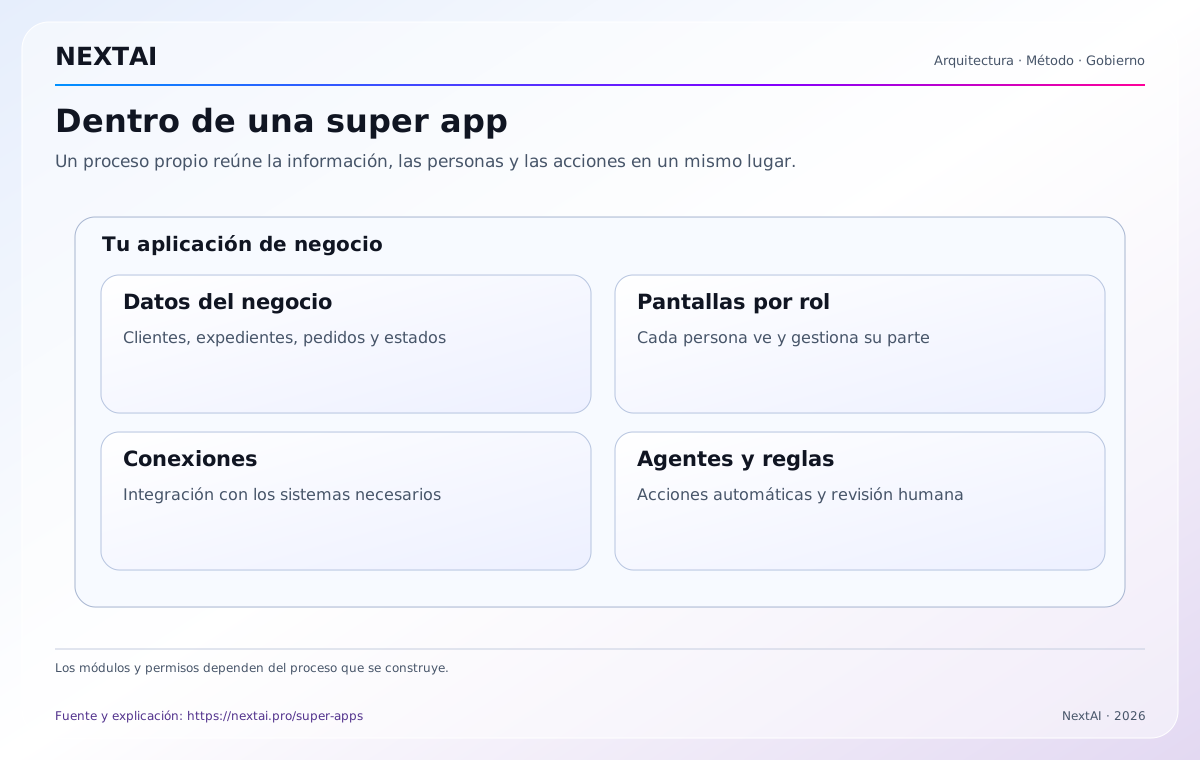
A super app is a bespoke business application that brings together in a single product the data, the screens, the roles, the automations and the artificial intelligence agents of a process or of an entire area. It replaces the pile of spreadsheets, forms and generic tools with a system of your own that works exactly the way your company works.
to the first usable version with real data
instead of five tools and fourteen spreadsheets
the app does not just record the work: it does it
Everything a process needs in order to live in one place
( 12 capabilities )This is not a feature list to pick three items from. It is the set that lets an app carry a real operation: your own data, roles, integrations, agents and audit from day one.
Your own data model
The real entities of your business —site, case file, member, route, batch, incident— with their relationships, their states and their rules. Not generic fields forced into a tool that was never designed for you.
Screens by role
Management sees indicators, operations sees the work queue, admin sees documents and the client sees only their own case. Each profile logs in and finds their work, not a menu with sixty options.
Permissions and isolation
Record-level rules: every user, client or branch can reach only what belongs to them. This is the requirement that decides whether an app can be opened up to third parties.
Agents inside the app
The agent does not live in a separate tab: it reads the same data, acts on the same screens and leaves a record of what it resolved on its own and what it passed to a person.
Documents and reports
Quotes, contracts, reports and grant justifications generated from data already validated in the system. No more copying by hand between a template and a spreadsheet.
Reading incoming documents
Invoices, delivery notes, PDFs, spreadsheets and emails arriving from outside are read, extracted and turned into structured records without typing.
Integration with what you already use
ERP, CRM, invoicing, e-signature, payment gateway, calendars, storage and messaging. The app sits on top of your stack, not in its place.
Payments and subscriptions
One-off payments, recurring fees, client portals and automatic reconciliation of each payment with the case file that produced it.
Automations and alerts
Time-based and event-based rules: due dates, reminders, escalations, periodic summaries and alerts to the right owner at the right moment.
Operational analytics
Dashboards built on the real data of the process, with the same figure for the whole management team. It includes the RAO of every automated flow.
Mobile and field access
It works on the phone of the technician, the sales rep or the operator: job sheets, photos, signatures and states updated where the work happens.
Audit and accountability
Immutable history of actions, consents, document versions and traceability of every automated decision. Ready for internal audit and for European AI regulation.
Eight sectors. The same underlying problem.
( real examples )The sectors have nothing in common, but the pattern is identical: a critical process split between spreadsheets, emails and what people happen to remember. This is what a super app replaces in each of them.
From order to payment, in one system
Orders, production, shipments, delivery notes and invoice reconciliation in a single flow. The agent reconciles whatever matches and leaves admin only the exceptions.
Sites, job sheets and progress billing
Every site with its budget, its job sheets from the phone, its photos, its hours and its monthly progress billing generated from data already captured. Without redoing the same old spreadsheet.
Client case files with their own portal
One case file per client, documents requested and uploaded through their own portal, deadlines under watch and deliverables produced from the information in the file.
Monitoring, custody and justification
A radar of open calls, document control for every grant awarded, deadline alerts and the justification account assembled from what is already in the system.
Comparable operations across sites
Checklists, incidents, recipe costing, waste and staffing per site, with the same figure for everyone and automatic comparison between locations.
Members, sign-ups and activity
Registrations, recurring fees, access control, segmented communication and tracking of each member's activity.
Routes, paperwork and traceability
Route planning, documents per service, signatures on delivery and settlement with a full record of what happened on each trip.
Programmes, students and submissions
Catalogue, enrolments, progress tracking, submissions marked with AI support and completion records issued automatically.
You have already tried the alternatives
Almost no company gets here without having tried to solve it another way first. These are the four usual routes and where each one breaks.
Against off-the-shelf software
Standard software forces you to adapt your operation to its way of thinking and to pay for modules you never use. A super app starts from your real process and leaves everything else out.
Against spreadsheets
A spreadsheet is fast until there are five versions, nobody knows which one is right and a broken formula costs a month of invoicing. The app keeps a single truth and a record of who changed what.
Against traditional development
A classic project delivers in quarters and quotes for every change. We deliver the first usable version in weeks and evolve it on real use, not on a specification written six months ago.
Against a pile of separate automations
Isolated flows solve tasks and multiply invisible points of failure. The app is the place where the whole process lives, with state, history and owners.
From the first conversation to production in eight weeks
( 5 phases )Each phase ends in something you can use and judge. None of them commits you to signing the next one.
Mapping the process
A working session to draw how it works today: who does what, where it breaks, which data is lost and which decision is taken blind. We come out with the data model and the scope of the first version.
First usable version
Not a mock-up: the app with its data model, its main screens and its complete flow, already loaded with real data from your operation so you can judge it properly.
Integrations and agents
We connect what you already use and switch on the first agents over the most repetitive tasks, with authority limits written down before they are activated.
Going live
Roles, permissions, team training, migration of historical data and an orderly overlap with the old way of working until it is no longer needed.
Measurement and next process
Monthly review of the RAO and of the business indicators. With the foundation built, each new process costs a fraction of the first one.
A super app is the way in
The app is where the process lives and gets measured. Once that foundation exists, the next two services stop being a research project: superagents use its data to run complete processes, and the Enterprise Brain connects that app to the rest of the company so everything shares a single memory. You can walk the path in whatever order suits you: the NEXT-5 Roadmap orders it and the RAO measures it.
What people always ask us
( 6 questions )What exactly is a super app?
A bespoke business application that brings together in a single product the data, the screens, the roles, the automations and the AI agents of a process or of an entire area. Instead of adding up generic tools and spreadsheets, you have your own system that works exactly the way your company works.
How long until it is up and running?
The first usable version, with real data and the main flow complete, lands between the second and the third week. Going live with roles, integrations and agents usually closes between the sixth and the eighth.
I only have an idea, there is no company yet. Does this still work?
Yes. We work the same way with an idea as with an operation of two hundred people: we draw the process, build the product and set up the infrastructure for the day it grows, because on that day you will need exactly what an established company needs.
Does it replace my ERP or my CRM?
Usually not. The super app sits on top of your stack and connects to what already works; it replaces what today lives in spreadsheets, emails and informal processes. When the old system is the problem, we say so and we put it forward as an explicit migration.
Is the app ours?
Yes. The data model, the logic and the content belong to your company, and the data can be exported at any time. We work with a data processing agreement and hosting in the European Union.
Can it start small?
That is the recommended way. You start with one process where the pain is measurable, put it into production and measure it. Each following process builds on the data model already in place, so it costs considerably less than the first one.
Tell us the process.
We will tell you which app it needs.
One hour, no sales deck: we draw your process, mark where it breaks and tell you what to build first, what can be automated now and what is not worth touching yet.
Build your service. See your estimate.
Choose what your process needs. See indicative setup and monthly costs instantly, without sharing your contact details.
Ready to apply this to your business?
Eva helps you choose. Our team scopes your project.