


NextAI Labs · Real case study

Sophia: Percent's enterprise brain

How Percent Servicios Inmobiliarios, with 150 employees and a presence across several provinces in Spain and Portugal, unified data, eight channels, 31 automated processes and AI agents in one measurable operating system.

Executive summary
Executive summary · Sophia

From five scattered systems to a property operating system

Between February and September 2026, NextAI designed and deployed Sophia for Percent Servicios Inmobiliarios, an organisation with 150 employees, 14 offices and a presence across several provinces in Spain and Portugal. It unified data, acquisition, qualification, assignment, matching, follow-up and management control on a governed architecture.

measured
156,322

unified contacts

measured
8

connected inbound channels

measured
31

automated processes in production

measured
68 h → 13.2 h

median time to first contact

measured
64 → 1

new duplicates per week

updated scope
Thousands of hours

of repetitive work absorbed

Figures marked “measured” come from system checks and field audits. “Thousands of hours” reflects the updated cumulative scope supplied by the project; it is not converted into financial value or eliminated jobs without specific reconciliation.

The size of the challenge

A business domain too large for human memory

Once an organisation reaches a certain scale, the problem stops being a lack of tools. The problem is that no single person can hold the full state of the business in their head. These figures describe the historical perimeter of the ecosystem we worked on.

150

employees

14

connected offices

+2M

photographs managed

+100,000

properties in the updated scope

156,322

contacts unified in the documented measurement

Updated scope supplied by the project. The initial dossier verified an earlier snapshot of 42,063 properties and 18,534 migrated photographs; the higher figures describe subsequent cumulative growth, not one migration batch.

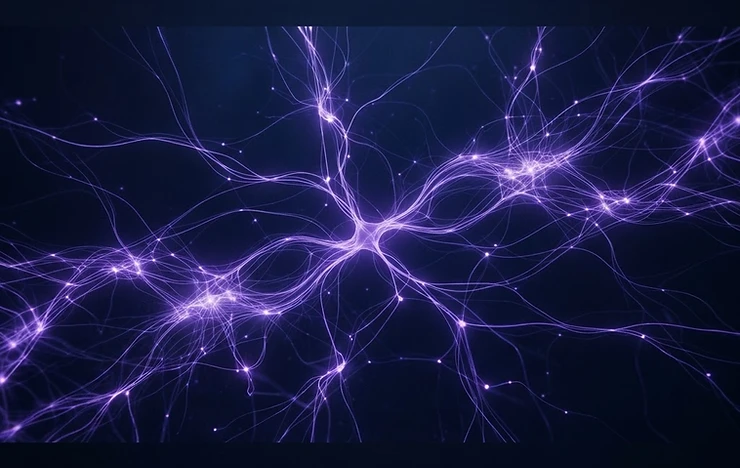
An abstract rendering of the business domain modelled as connected data

The business domain, modelled as a connected data structure

The company behind the project

Percent Servicios Inmobiliarios

Percent Servicios Inmobiliarios has 150 employees and operates across several provinces in Spain and Portugal. Its operation spans connected offices, sales teams and management processes, with years of operational history and a volume of information that grows every day.

The starting point was not a disorganised company. It was a large one. And in large companies the invisible cost is not in doing things: it is in knowing, at any given moment, what state everything is in.

The change of approach

Automating is not the same as thinking

An automation answers a simple, closed question. An enterprise brain answers a question that demands context, judgement and memory. That difference reshaped the project: it was no longer about adding automations around the existing organisation but about revisiting how the organisation should work.

Automation

What action should run after this event?

Enterprise Brain

What does this event mean, which state does it change, which process applies, who should step in and what should be remembered for next time?

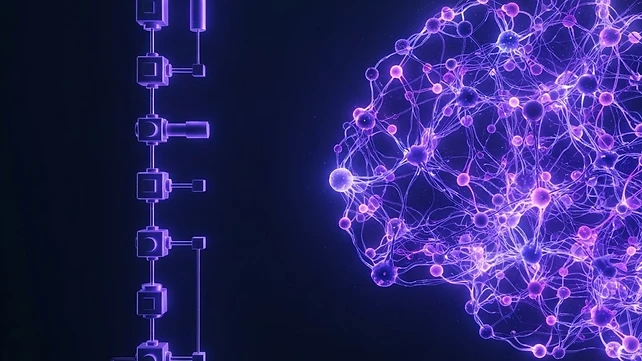
A visual contrast between a linear automation chain and a dense neural network

A linear chain against a network that interprets

The operational redesign

Five functions the organisation learned to do on its own

The work was not about replacing people but about freeing people from holding the system up. The operation came to rest on five continuous capabilities.

Perception

Every interaction, document and business signal becomes structured, comparable information.

Coordination

States and deadlines stop living in individual diaries: the system creates tasks, detects inactivity and escalates exceptions.

Decision

Priorities are calculated on the real state of the business, not on the last conversation somebody remembers.

Execution

Processes move forward on their own up to the exact point where human judgement adds value.

Learning

Every cycle leaves a trace: what works is consolidated and what fails is corrected in the model, not in someone's memory.

Functional inventory

What was built and put into production

Sophia is not a chatbot added to a CRM. It is a connected operation: 22+ systems, 31 automations and specialist agents work on the same context, with permissions and traceability.

Unified data

Contacts, properties, prospects and historical operations on one cleaned, shared model.

Multi-channel acquisition

Eight connected channels with deduplication, assignment, SLA and source traceability.

Voice agent

Carmen answers 24/7, structures conversations and turns 76% of handled calls into leads.

Conversational agent

WhatsApp qualifies enquiries within defined limits; the channel was under review at the cut-off date.

Contextual SophIA

An assistant embedded in work screens to query and act on authorised context.

Matching engine

Recalculates enquiry-to-property affinity and presents suggestions in each record.

Document engines

End-to-end intake, classification, extraction, validation, generation and traceability of business documents.

Third-party services

Reusable automations and bounded services prepared to operate at scale for external customers.

Management and control

Operational dashboards, a 124-KPI catalogue, seven access profiles and activity records.

Evolving AI layer

Provider-independent architecture: current models can replace earlier generations without redesigning the process.

The AI layer is described by function and capability, not a specific commercial version. This avoids presenting a model name that changes over time as permanent.

Hybrid architecture

Deterministic structure, flexible intelligence

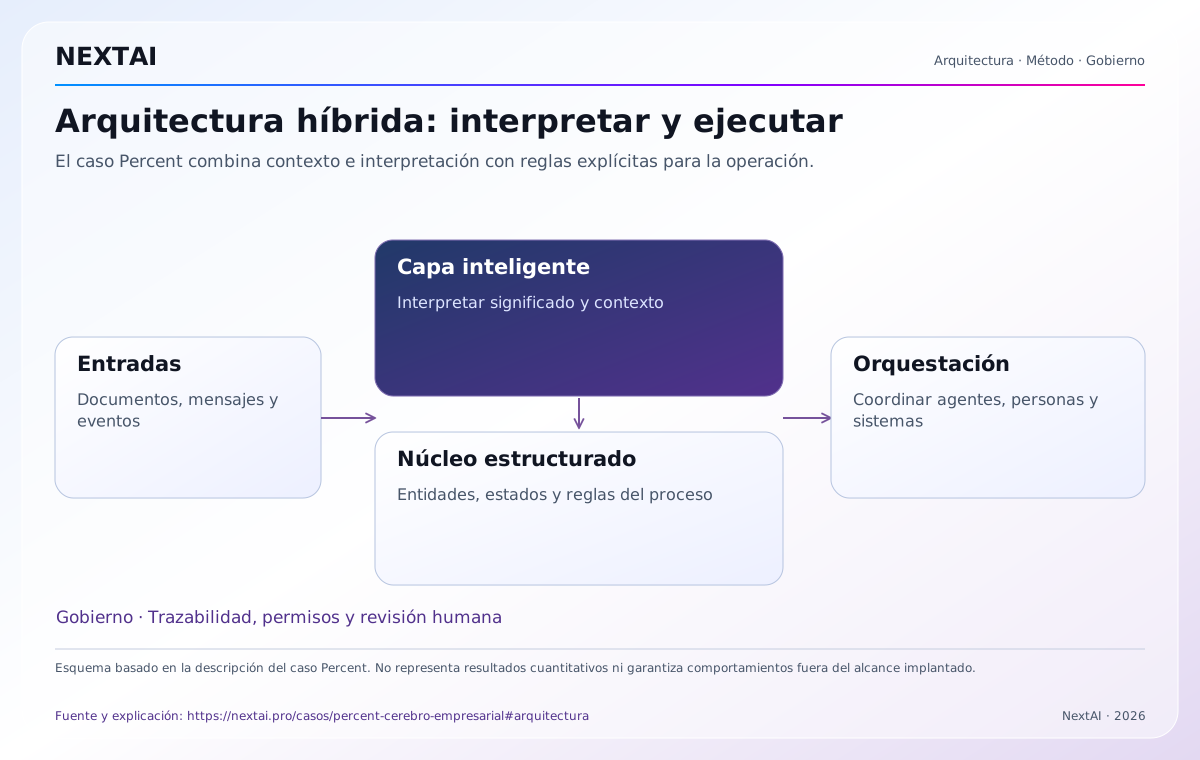
An enterprise brain cannot be only a language model, nor only a set of rules. It needs a stable core that guarantees consistency and an intelligent layer that provides interpretation. What is critical always runs the same way; what is ambiguous gets interpreted.

Hybrid architecture: interpret and execute

The Percent case combines context and interpretation with explicit rules for the operation.

Download SVG
InputsDocuments, messages and events
Intelligent layerInterpret meaning and context
Structured coreEntities, states and process rules
OrchestrationCoordinate agents, people and systems
GovernanceTraceability, permissions and human review

Diagram based on the description of the Percent case. It does not represent quantitative results or guarantee behaviour outside the scope implemented.

Five layers

The anatomy of the system

Sophia was documented as a five-layer architecture: data, processes, intelligence, interaction and governance. Value emerges when they work as one system.

01
Data

One model for contacts, properties, enquiries, opportunities and operations.

02
Processes

Thirty-one production automations maintain states, deadlines, assignment and quality.

03
Intelligence

Matching and assistants interpret context without replacing critical rules.

04
Interaction

Voice, WhatsApp, email, portals and screens operate on the same memory.

05
Governance

Role permissions, evidence, traceability and human escalation support delegation.

Seven translucent data layers stacked in perspective

Five connected layers, from data to governance

Governance and traceability

A system that runs on its own, but never blind

Every action the brain takes is recorded: what ran, with what information, under which rule and with what result. Traceability is what makes it possible to delegate without losing control, and what turns human supervision into an informed decision rather than an act of faith.

Judgement, negotiation and critical decisions remain human. The difference is that people stop spending their time reconstructing the state of things.

Measured outcomes

Before and after on the same system

The project introduced continuous operational measurement. Improvements are published with their unit and context, without duplicating figures or turning estimates into facts.

Sales responseBefore68 hAfter13.2 hMedian from arrival to first contact.
New duplicatesBefore64/weekAfter1/weekObserved reduction after launch.
Inbound channelsBefore3After8Acquisition connected to the common record.
Enquiry–property matchingBeforeManualAfterNightly recalculationTraceable suggestions in both records.
AI phone handlingBeforeIVR outside CRMAfter≈2,000 min/month76% of handled calls end as a structured lead.
Migration and scale

A clean, usable enterprise memory

The migration did not simply copy files: it rebuilt identities, relationships and history so agents, automations and people could work from one version of the business.

+100,000

properties · updated scope

+2M

photographs managed

156,322

contacts · documented measurement

40,363

prospects · documented measurement

2,964

historical operations

4,991

listings in the migration batch

The updated scope (+100,000 properties and +2 million photographs) was supplied after the documentary cut-off. It is distinguished from verified initial-batch figures; personal data, credentials and confidential financial detail are excluded.

Business impact

From internal efficiency to new market capacity

Sophia did more than reduce manual tasks. It turned internal capabilities into scalable, reusable infrastructure ready to create services.

Document engines

Complete systems to receive, classify, extract, validate, connect and generate documents with source traceability and review.

Operational capacity

The platform absorbed thousands of accumulated repetitive-work hours and workload equivalent to several roles, without presenting that equivalence as layoffs.

Reusable scale

Automations and services created for internal operations were prepared for higher volume and to offer specific capabilities to third parties.

Market expansion

Better acquisition, response speed, portfolio use and multi-channel coverage provided infrastructure to expand reach and market share.

The contribution to market share is described as enabling capacity; no causal percentage is claimed without reconciled commercial measurement.

Method and traceability

A case documented with evidence, not impressions

NextAI combined continuous audit, live verification, system traces, transcribed meetings and owner validation. Each claim is classified as measured data, estimate or context.

3,583

normalised evidence records

119

traced meetings

120 h

of transcribed conversation

25+

field audits

Training and documentation were treated as part of the product: role-based journeys, usage criteria and process validation. Economic outcomes remain estimates with explicit assumptions and pending financial reconciliation.

From the map to daily work

The network shares context; people retain judgement

This image represents a distributed organisation connected to shared memory. It does not depict real offices or a Percent interface: it visualises the coordination principle developed in this case.

A distributed property network connected to a shared archive.

Anatomy of the solution

Operational memory for a distributed organisation

From input to outcome: explore the four parts of the journey.

Signals

Eight channels, calls, messages, portals and documents.

Explanatory diagram based on the described solution. It simplifies the journey; it is not a deployed infrastructure diagram or a live monitor.

Reading the project

The thinking behind the technology

01 / Business

What really needed solving

In a property network, contacts, more than 100,000 properties, more than 2 million photographs, opportunities and documents belong to the same business. Sophia unified that context, built complete document engines and turned internal automations into scalable capabilities for the network and third-party services.


02 / Design

Why this structure matters

The architecture combines five layers: data, processes, intelligence, interaction and governance. Deterministic rules maintain consistency; agents handle ambiguous information; traceability preserves human control over relevant decisions.

Connection to today’s offering

Enterprise Brains

The context connecting the company

Explore the service

Current relevance and possible evolution

Percent illustrates an Enterprise Brain in production: Super apps materialise the workspace and Superagents handle specific journeys on shared memory.

This connects the case experience to our current services. Proposed extensions are not presented as features already delivered.

Method and scope

How to read the outcome

What to measure

Results compare the same system and publish unit, window and data type. Median time to first contact moved from 68 to 13.2 hours and new duplicates from 64 to 1 per week.

What not to infer

Verified operational metrics and clearly identified estimates are published. Personal data, credentials, sensitive internal rules and confidential financial detail are omitted; results are not a promise for other organisations.

Basis of this analysis: the description, capabilities and stack published in this case. No new measurements are added and no independent audit of its results is implied.

Comparison

Automation against an enterprise brain

The distinction is not a semantic one. It determines what an organisation can really delegate and what will still depend on somebody remembering.

Unit of work

One isolated task

A complete process with state

Context

None: it reacts to the trigger

The overall state of the business

Ambiguity

It fails or stops

It interprets and escalates if needed

Memory

It does not remember previous runs

It learns from every cycle

Human role

Keeping the automation alive

Setting judgement and supervising

Scale

More volume, more maintenance

More volume, more capacity

Maturity model

From using tools to an organisation that thinks

No company jumps straight to the last level. Maturity is built in layers, and each level is only stable once the one before it really works.

01
Tools

The company uses software. Coordination lives in people.

02
Automations

Specific tasks run on their own, but with no shared context.

03
Connected processes

The state of the business starts to be single and queryable.

04
Assisted operation

The system proposes, prioritises and prepares; the human decides.

05
Enterprise Brain

The organisation perceives, coordinates, executes and learns continuously.

A maturity gradient: from scattered points to a coherent structure of light

Maturity is not bought: it is built in layers

The asset nobody can copy

The valuable part is not the model: it is what has been learned

Any competitor can buy the same technology. What they cannot replicate is the accumulated operational knowledge: how this business behaves, which signals anticipate an opportunity, which exceptions recur and how they are resolved. That learning stays inside the brain and compounds over time.

A continuous learning loop rendered as a torus of violet light

Each cycle feeds the next

Although this case comes from the property sector, the pattern is not sector-specific. Any organisation with volume, distributed processes and decisions that depend on context faces the same problem: the operation grows faster than the human capacity to hold it together.

The next competitive advantage will not be having more tools. It will be building organisations able to perceive, coordinate, decide, execute and learn.

NextAI Labs

Is your company ready to have a brain?

We analyse your real operation — data, processes and decisions — and show you which part could run on its own and which part should stay human.

Ready to apply this to your business?

Eva helps you choose. Our team scopes your project.

Book an audit · €290 ↗