
Superagent
An agent that owns a whole process, not a task.
A Superagent is an AI agent that takes ownership of a business process end to end: it receives the trigger, queries the Enterprise Brain, executes the actions in your systems and escalates to a person only on exceptions. It is measured by its Operational Autonomy Ratio, not by how many messages it answers.
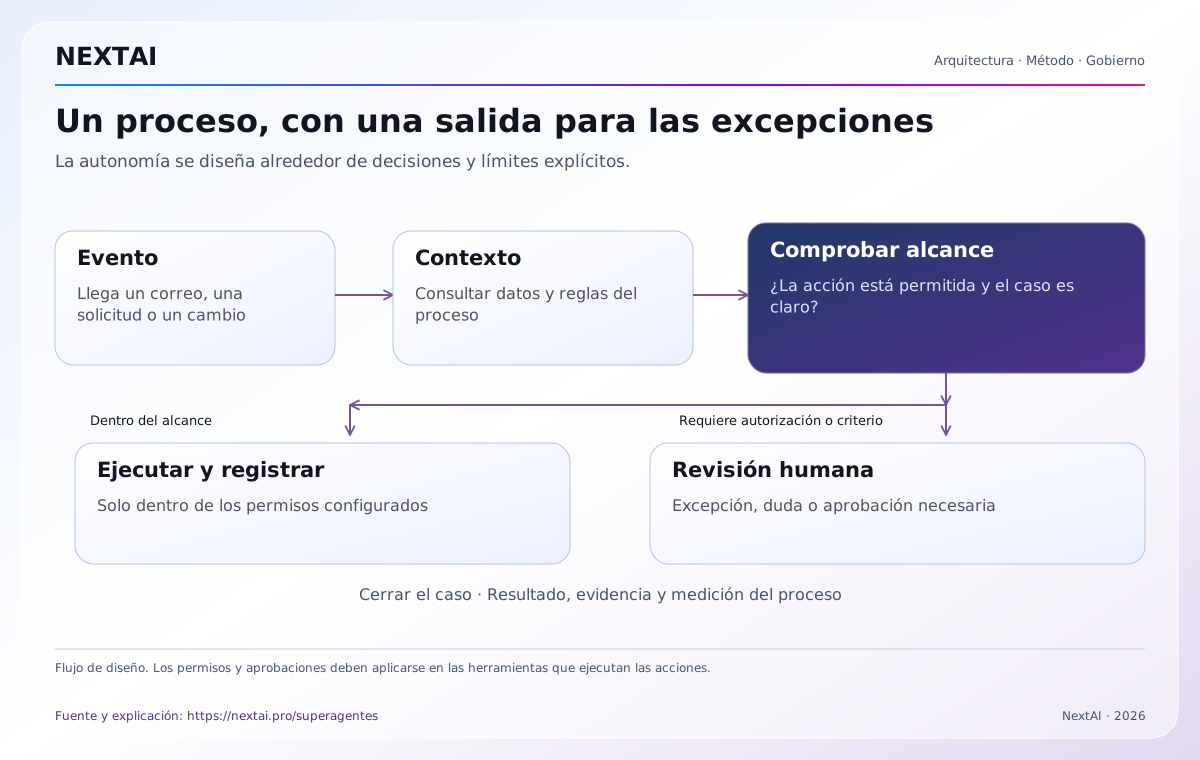
One process, with an exit for exceptions
Autonomy is designed around explicit decisions and limits.
Design flow. Permissions and approvals must be enforced in the tools that carry out the actions.
What a superagent is not
A more elaborate script still neither executes nor remembers. The leap is process ownership, not wording.
An if-then flow breaks on the first exception; a superagent reasons about the case and decides whether to escalate.
Its authority is declared before it is switched on and every action is audited.
From chatbot to superagent
( Four levels, one leap )Almost everything the market calls an “agent” lives at levels 2 and 3. The difference is not the quality of the text: it is how much work finishes without anyone touching it.
Chatbot
Answers from a script over an intent tree. It does not remember, does not execute and does not learn.
Copilot
Suggests inside a tool. It speeds the person up, but the person still does the work.
Task agent
Executes one narrow task autonomously: classify, extract, draft, update a field.
Superagent
Owns the complete process: triggers it, reasons over the Brain, executes it, closes it and documents it.
How a superagent works
( From trigger to close )A superagent does not wait for orders: it waits for events. This is the full cycle it runs every time its process is triggered.


A real event opens the process: an incoming email, a form, a stage change in the CRM, a time of day, a missed payment.
It queries the Enterprise Brain: customer history, internal policy, precedents and the documents that apply.
It breaks the process into steps and chooses tools. If a critical piece of data is missing, it asks before acting.
It writes to the systems: creates the record, sends the reply, issues the invoice, books the slot, updates the pipeline.
Faced with a high amount, ambiguity or risk, it stops and escalates to a person with the case file already assembled.
It documents what was done, leaves an auditable trace and returns the result to the channel where the process began.
One superagent, several processes
( Without changing your tools )A superagent is not a per-task automation. It takes charge of several complete processes in parallel and runs them on the stack your company already has.


Several processes at once
A single superagent can run more than one process: quoting, follow-up and chasing late payments can live in the same agent when they share context and systems.
One agent, several entry points
Each process has its own trigger — an email, a form, a stage change, a time of day — and the agent decides which one it handles without mixing criteria.
On your current stack
You do not need Cortex or any platform of ours: the superagent connects to the tools you already use and works inside them.
Zero migration
Your CRM, your ERP, your email and your spreadsheets remain the source and the destination. Nothing is replaced and your data does not move.
The processes handed over first
( The real flow, step by step )You start with processes of high volume, repeatable judgement and reversible consequences. The RAO figures are indicative reference ranges, not promises.
Sales
RAO ~78%From lead to sales-ready opportunity
- 1The lead arrives via the website, WhatsApp or LinkedIn
- 2The agent researches the company and cross-checks it against history
- 3It scores, discards or books a meeting with the right person
- 4It writes the opportunity and the note into the CRM
Customer service
RAO ~84%Case opened, case closed
- 1The query arrives by email, chat or WhatsApp
- 2It retrieves the contract, orders and previous incidents
- 3It resolves the case or processes it in the system
- 4It escalates only for complaints or contractual exceptions
Finance
RAO ~71%From the document to the settled entry
- 1It captures the invoice from email or the supplier portal
- 2It extracts, validates against the order and spots discrepancies
- 3It posts the entry and reconciles the bank movement
- 4It chases late payments with escalation by ageing
Operations and purchasing
RAO ~66%Management by exception
- 1It watches stock, lead times and reorder points
- 2It compares real consumption against the forecast
- 3It issues the purchase proposal to the right supplier
- 4It raises an alert only when the scenario falls outside range
The systems it executes in
( It writes, not just reads )A superagent is worth what it leaves done, not what it looks up. It connects to your current stack — with no platform of ours in between — and writes to it: the same tools, the same permissions and the same records your team uses.


CRM and sales
ERP, finance and payments
Communication and channels
Documents and productivity
Projects and operations
Data and analytics
Marketing and visibility
People and governance
How far it can go on its own
( Declared authority )The question that decides whether a superagent reaches production is not what it can do, but what it is allowed to do without asking. That is declared before it is switched on.
Full autonomy
Reversible, low-impact actions: classify, reply, update, schedule, document.
Autonomy with notice
Executes and notifies: issuing a standard invoice, creating a record, sending to a known customer.
Prior approval
Amount above threshold, terms outside policy, customer in dispute, sensitive personal data.
Forbidden
Anything not declared within its scope. The agent does not improvise outside its registry entry.
Los superagentes también hablan
Nuestros superagentes llaman por teléfono y también se les puede llamar. Voces naturales en español de España, 24/7, desde 0,20 € por minuto. Pruébalos en vivo.
Ver agentes de vozHow does Superagent apply to your company?
Tell us how your operation works today and we will tell you what can be built and where to start.
Book your Digital AuditBuild your service. See your estimate.
Choose what your process needs. See indicative setup and monthly costs instantly, without sharing your contact details.
Ready to apply this to your business?
Eva helps you choose. Our team scopes your project.