
RAO
The metric that replaces vanity metrics.
RAO (Operational Autonomy Ratio) measures what percentage of a process runs end to end with no human intervention. It replaces vanity metrics — queries, active users, messages — with the only question that matters: how much work gets done on its own.
How much work finishes without intervention?
Try the RAO calculation for a process. Change the total runs and the ones completed without human intervention.
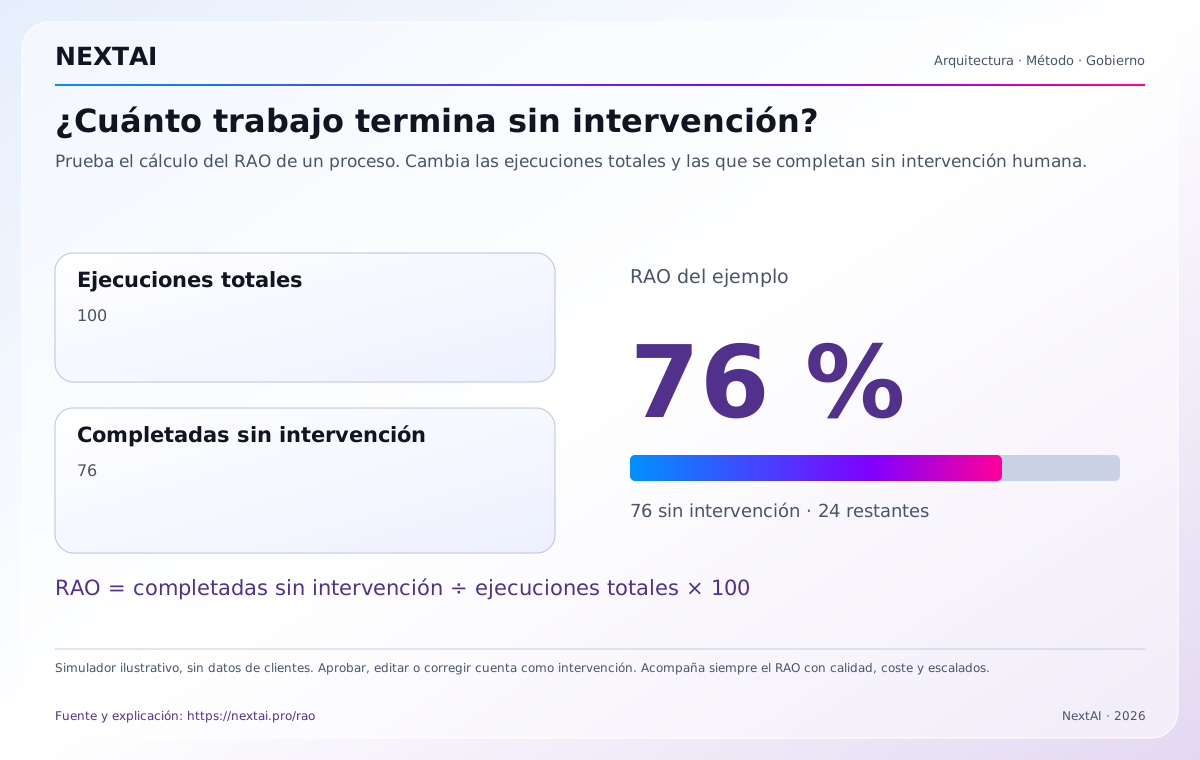
Count complete runs of a single process over a single period.
RAO = completed without intervention ÷ total × 100
Illustrative simulator, with no customer data. Approving, editing or correcting counts as intervention. Always report RAO alongside quality, cost and escalations.
How it is calculated
RAO = runs completed without intervention ÷ total runs of the process.
There is no company-wide RAO: there is a RAO for each process.
Below 40% the process is still manual work with assistance.
Above 70% the agent owns the process and people handle exceptions.
Why a metric exists just for this
( The question the board asks )RAO was not created to replace business indicators but to fill a gap: none of the dashboards a company already uses answers how much work finishes without a person touching it.
The problem it solves
When a company starts using artificial intelligence, the board's question is not how many licences are active: it is what work has stopped passing through a person's hands. Without an execution metric, that question gets answered with impressions — the team says it helps, the vendor shows a demo — while the cost keeps running.
How it differs from what an SME already measures
The usual measures are estimated hours saved, queries handled or the share of staff with access to the tool. All three go up even when the work is untouched: someone can fire off twenty queries and still write the answer by hand. RAO counts completed runs, which is a figure you can check against the system log.
Measured per process, never per company
Every process has its own volume, complexity and ceiling. Averaging supplier invoicing with complaint handling produces a number that supports no decision. What does work is publishing the list of processes with their individual RAO and their month-on-month trend.
What counts as human intervention
Editing, approving, correcting or re-entering a piece of data. If the process requires mandatory sign-off for internal control, those runs are not autonomous and the process has a structural ceiling below 100%. That is not an agent failure: it is a governance decision worth writing down.
It is never published on its own
A high RAO with frequent errors is not autonomy, it is risk. The figure always travels with accuracy measured on a control sample, escalation rate — how many cases the agent hands to a person on purpose — and cost per run.
What each band means
( From pilot to autonomy )The bands are not a grading scale: each one has a recognisable symptom in the operation and a single sensible next step. Widening the scope in the wrong band is the most common way to burn budget.
| RAO band | Symptom in the operation | Reading | Next step |
|---|---|---|---|
| 0–15% | The agent works in demos and almost nothing reaches the end unaided | Proof of concept | Do not scale: review the available context and narrow the process |
| 16–39% | The team uses AI as a first draft and redoes the result | Manual work with assistance | Cut the scope until one whole process closes, not half of one |
| 40–69% | The process adds value but someone reviews nearly every run | Production threshold | Cover the recurring cases that still escalate and stabilise accuracy |
| 70–85% | The team reviews exceptions, not runs | The agent owns the process | Move to sample-based supervision and open the next process |
| > 85% | The process runs by itself for weeks at a time | Mature autonomy | Watch for drift and accuracy drops; review authority thresholds |
The bands are the criteria NextAI uses to validate the autonomy of a process, not an industry standard.
An invoicing process with 100 runs a month
( How it is really calculated )The fastest way to understand RAO is to follow a single process over nine months at a round volume, so the number of autonomous runs matches the percentage.
The figures in this section are a worked assumption used to explain the calculation. They are not a market figure or the result of a specific client.
Receiving, validating and posting supplier invoices.
100 runs a month, so the calculation reads directly as a percentage.
Invoice checked against the order and posted, with nobody editing or approving.
RAO = runs completed without intervention ÷ 100. An approval counts as intervention.
| Point in time | Completed unaided | With intervention | RAO | What changed |
|---|---|---|---|---|
| Baseline | 0 | 100 | 0% | The whole process is done by hand; logging is instrumented |
| Month 2 | 12 | 88 | 12% | The agent extracts and proposes; a person always approves |
| Month 4 | 38 | 62 | 38% | Price lists and framework contracts are loaded into the Enterprise Brain |
| Month 6 | 64 | 36 | 64% | Amount thresholds are raised for regular suppliers |
| Month 9 | 76 | 24 | 76% | Only price discrepancies and unreadable documents remain as exceptions |
The calculation, no tricks
In month 9, 76 runs out of 100 finish without anyone touching anything: a RAO of 76%. The other 24 are not failures; they are cases the agent hands over because it is not allowed to settle them alone.
What moved the needle was not the model
Between month 4 and month 9 the model did not change. The available context did: price lists, framework contracts and past discrepancies. Autonomy is a memory problem before it is a model problem.
Where the figure would be distorted
If the difficult invoices were set aside before entering, the denominator would fall and RAO would rise without the work changing. That is why every run started counts, including the abandoned ones.
What this figure decides
At a steady 76% with stable accuracy, supervision moves to sampling and the team frees up time for the next process. At 38% the right decision is to narrow the scope, not widen it.
An example built to explain the calculation. The pace of improvement depends on the process, the volume and the context available in each company.
What RAO is not
( Five ways to inflate it )A badly calculated RAO is worse than not measuring: it gives the confidence to scale a process that still depends on a person in every run.
It is not a share of headcount
Having 90% of the team using AI daily adds not one point of RAO. RAO is about runs that finish on their own, not about people opening a tool.
It is not the automation rate
A process can have 80% of its steps automated and a RAO of 0% if the remaining step always needs a person. You count the whole process, not the step.
It is not a quality measure
RAO says how much gets done on its own, not how well. Without accuracy measured on a hand-reviewed sample, a high figure may simply be describing fast mistakes.
It is not measured in one good week
Below a month, seasonality and exceptions distort the result. The shortest sensible period is monthly, and what matters is the trend, not the peak.
It should not be the team's target
If someone is paid to raise RAO, they will stop escalating cases that ought to be escalated. It is a diagnostic indicator, not an individual incentive.
Where RAO fits in the NEXTAI system
( One metric, five pieces )RAO is the indicator that ties the rest of the system together: it evidences the level on the Scale, sets the targets of the Roadmap, measures the work of the superagents and feeds the Agency axis of IMAN.
Frequently asked questions about RAO
( What the board asks )What counts as a good RAO?
It depends on the process, but there are two reference points. Below 40% the process is still manual work with assistance. Above 70% the agent owns it and people handle exceptions. A process with mandatory approval will have a lower ceiling, and that is correct.
Can you calculate a company-wide RAO?
Not usefully. Averaging processes with different volumes and ceilings gives a figure that supports no decision. What does make sense is publishing each process with its RAO and its trend, and using that list as an autonomy dashboard.
What does it mean if RAO drops from one month to the next?
Almost always something has changed in the data or in the business rules, not in the model. The review starts with context: new price lists, a different document format, a supplier that changed its process. A drop of more than ten points deserves immediate review.
Do you need an Enterprise Brain to reach a high RAO?
For very closed processes, no. For anything that depends on in-house knowledge — price lists, contracts, precedents, internal criteria — yes: without queryable memory the agent settles the standard cases and escalates the rest, and the figure stalls.
Does a high RAO mean the company has too many people?
That is not what we see in practice. What usually happens is that the team moves from executing to supervising exceptions and checking quality, and the company absorbs more volume without growing its administrative structure. New roles also appear: agent owner and context curator.
How does RAO apply to your company?
Tell us how your operation works today and we will tell you what can be built and where to start.
Book your Digital AuditReady to apply this to your business?
Eva helps you choose. Our team scopes your project.