
Your company.
Run by AI.
Without the old stack.
Cortex is the infrastructure we use to build companies run by artificial intelligence: a multi-layer architecture — data, memory, reasoning, execution agents, voice desk and governance — that takes on up to 80–90% of the operation that can be digitalised. It does not sit on top of your ERP, your CRM, your helpdesk and your automations: it replaces them. People keep what needs to be human: vision, judgement, relationships, negotiation and critical decisions.
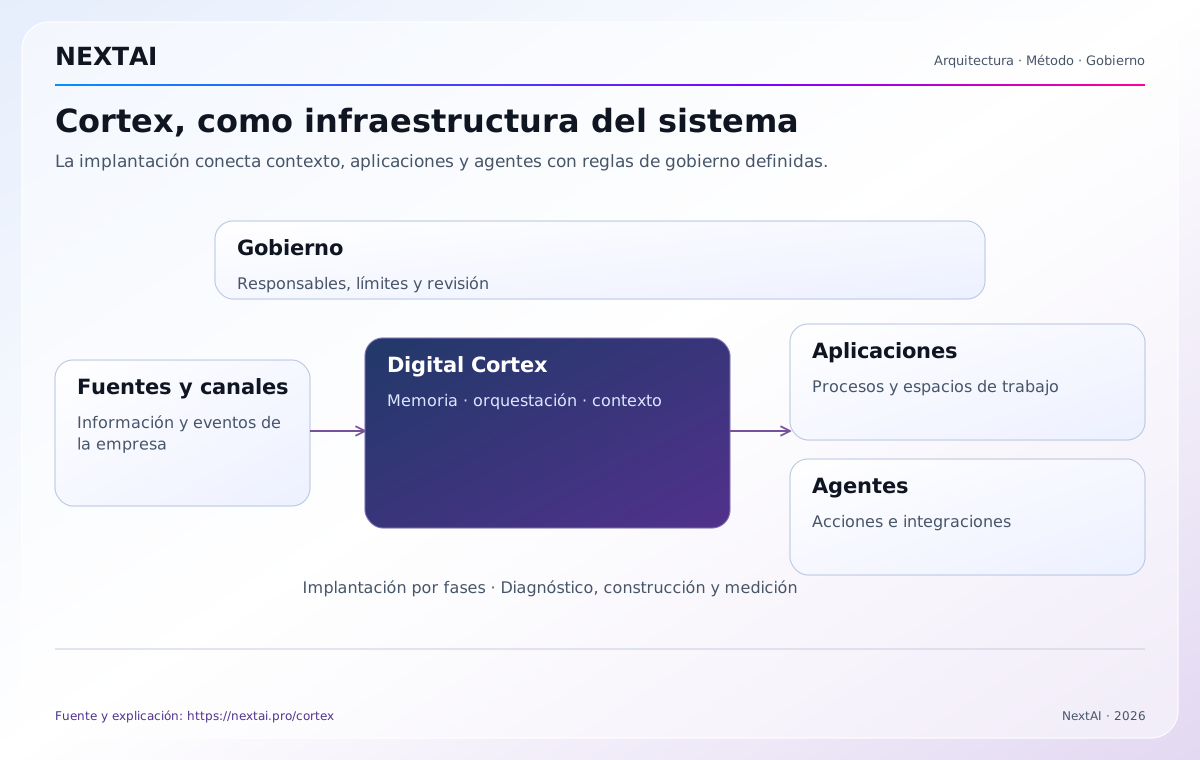
Cortex, as the system's infrastructure
The rollout connects context, applications and agents under defined governance rules.
From a company run by people to a company run by AI
Operational diagnosis
We map every process in your company and separate what can be digitalised from what needs human judgement.
Absorbing the data layer
What the ERP, the CRM, the master spreadsheets and the document manager hold today moves into a single queryable memory, with origin, date and permission on every piece of data.
Agents, voice and channels
Superagents take on complete processes — sales, administration, support, analysis, monitoring — and the voice desk and customer channels are handled by whoever already knows the full history.
Governance and retiring the old stack
Control points, authority limits and an audit trail of every action. And, process by process, the orderly retirement of the tools the system has already replaced.
It does not plug in. It replaces.
( Layer by layer )During the transition we integrate with what you already have, because nobody switches their company off on a Monday. But the destination is not a stack with AI on top: it is an architecture where your systems stop being systems and become, at most, data sources. This is what each layer takes over.
Data and memory layer
The ERP and the CRM stop being the system where work happens and become, at most, a source during the transition. The real record of customers, operations, contracts and decisions lives in the brain's memory, which does understand what it holds.
A single queryable memory, with origin, date and permission on every piece of data
Communication layer
The voice desk and the ticket queue exist because conversations have to be shared out among people. When the one answering is an agent that already knows the customer, their history and their contracts, the queue disappears: there is nothing left to share out.
Voice, email and customer channels handled by agents with full context
Execution layer
An automation only knows how to repeat the expected path and breaks on the first exception. A superagent reasons about the specific case, decides, executes in whichever system applies and escalates to a person only when the exception warrants it.
Superagents that own the complete process, with declared authority
Analysis and governance layer
BI exists so that someone looks at a dashboard and draws a conclusion. Here the conclusion arrives written, with the source identified, and in many cases with the action already taken and recorded. The dashboard stops being the product.
Answers with the source cited and an audit trail of every action executed
What Cortex is and why it exists
( The infrastructure )Cortex is not one more tool in the catalogue: it is the base on which a specific company's Enterprise Brain is built, with the data layer, the agents, the orchestration and the governance already solved.
What it actually is
Digital Cortex is the infrastructure we build with: data layer, memory, agent orchestration and governance already solved. It is not a programme installed in a company, it is what avoids starting from zero on every project.
What problem it solves
Without a common base, every rollout reinvents the same things: connectors, permissions, action logging and cost control per run. That repeated work is why many AI projects stay at pilot stage: the budget runs out before reaching the part that adds value.
How it differs from buying software
A licence adds one more tool to the stack. Cortex does the opposite: as processes move into the system, tools paid for per user stop being needed. The replacement is gradual and process by process, never a big-bang switch.
What stays on the human side
Vision, judgement, relationships, negotiation and critical decisions. The aim is not a company without people: it is a company where people do not spend the day moving data from one system to another.
What changes compared with what a company already uses
( Five functions )The useful comparison is not with another artificial intelligence product but with the way these five functions are handled today inside a mid-sized company.
| Function | How an SME solves it today | What changes on Cortex |
|---|---|---|
| Where the data lives | Spread across ERP, CRM, email, spreadsheets and shared folders | A single memory with origin, date and permission on every piece of data, without switching the sources off at once |
| How things are found | By asking the person who has been at the company longest | Semantic search and a relationship graph, with the internal source cited in every answer |
| Who executes | People moving information between screens, and automations that break on the exception | Superagents that own complete processes and escalate only what is declared as an exception |
| Who handles the channels | A voice desk, a shared inbox and a helpdesk, each with its own history | The same system that knows the whole history handles voice, email and customer channels |
| Who answers for what was done | Reconstructed afterwards by going through emails | An agent registry, authority limits by amount and criticality, and an auditable trace of every action |
What Cortex is not
( Four misunderstandings )Almost every wrong expectation comes from the same place: treating this as a software purchase rather than as a change in how processes are run.
It is not a corporate chatbot
Answering well is not the goal. The goal is for a process to finish: the invoice posted or the case closed, not for someone to receive a correct piece of text.
It is not a data migration
You do not start by emptying the ERP. Live sources are connected, work happens on top of them, and only then, process by process, is whatever the system has already replaced retired.
It is not rolled out over a weekend
The sensible sequence is phases with decision gates. A ninety-day schedule covers one process through to production; a coordinated ecosystem is measured in months.
It does not remove human governance
The more autonomy there is, the more it matters who authorised what. Limits are written before each agent is switched on and reviewed on a fixed schedule.
How it fits with the rest of the system
( From infrastructure to result )Cortex is the how; the Enterprise Brain is the what; the superagents execute; the NEXT-5 Roadmap orders the path; RAO proves it; the Digital ID accounts for who did what.
- [ 01 ]The 5-layer architecture of the Enterprise Brain
- [ 02 ]Rolling out AI in your company: a 90-day plan step by step
- [ 03 ]Modular AI architecture: the end of vendor lock-in
- [ 04 ]Multi-agent orchestration: keeping 10 agents out of each other's way
- [ 05 ]AI governance: how to keep an AI agent registry
Frequently asked questions about Cortex
( What the board asks )Do we have to stop using our current ERP and CRM?
Not to start. Cortex connects to what already exists and works on top of it with full traceability. If over time a system stops adding value because the process now lives in the Brain, retirement is considered process by process and in an orderly way.
How much of the operation can the system take over?
The part that can be digitalised: whatever today consists of reading, checking, deciding against a known rule and writing to a system. Anything requiring judgement, relationship or negotiation stays human, and it is worth setting that boundary in writing before starting.
Where does the data sit?
The deployment is defined with the company: which sources are connected, what is kept, under which permissions and for how long. Every answer and every action carries its identified origin, which is what makes later auditing possible.
What happens if an agent gets something wrong?
There is a record of what it queried, what it decided and under what authority. That trace lets you correct the context or lower the agent's thresholds. That is why authority limits are defined before go-live and not after the first incident.
Is there a case built entirely this way?
Yes: Subvia.es was built entirely on this infrastructure. Its system interprets public regulation, spots open calls and runs the business cycle, with a human team setting the strategy and validating the direction.
Subvia: an entire company run by AI


Subvia.es — public funding intelligence — was built from scratch on Cortex infrastructure. Its brain spots open calls, interprets the regulatory terms and turns public rules into concrete opportunities for companies. The whole cycle — prospecting, content, customer and payment — is run by AI.
It publishes daily on its blog, LinkedIn and social channels with no human involvement.
It invoices, manages users and runs the business processes autonomously.
A human team sets the strategy and validates the direction.
Start designing your AI-native company
Go to the Digital Cortex platform to see the full process, the real cases and how to get started.
Go to Digital CortexReady to apply this to your business?
Eva helps you choose. Our team scopes your project.