Chatbot vs copilot vs agent vs superagent: the 4 real levels
The technical differences between chatbots, copilots, task agents and superagents, with a detailed look at cost, autonomy and what it takes to deploy each one.
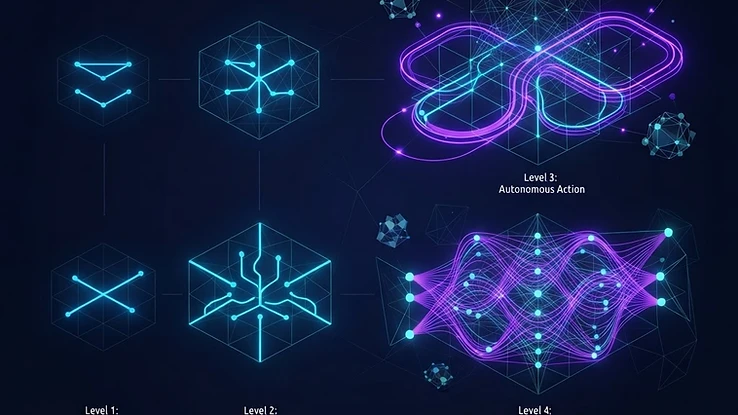

Chatbot, copilot, agent and superagent: a distinction worth making
The gulf between a chatbot and an AI agent is not in the ability to process language, but in the degree of responsibility. A chatbot limits its work to the query, a copilot assists the user in execution. A task agent breaks down and resolves specific processes. At the top, a superagent takes charge of a complete business operation, with memory, defined limits of authority and the ability to answer for its own KPIs.

In short
- Four categories, four levels of responsibility: answer, assist, execute and own.
- What goes up a level is not the model: it is access to data, to tools and to the decision.
- A chatbot is measured in queries resolved; a Superagent, in RAO and in the process KPI.
- Almost every failed AI project bought one level and expected the next.
- Without an Enterprise Brain underneath, none of the four categories knows your business.
What is the difference between a chatbot and an AI agent?
A chatbot returns text. An agent changes the state of a system.
That is the practical boundary: if at the end of the interaction there is a new record in the ERP, an email sent or a ticket closed, there was an agent. If there is only an answer on screen, there was a chatbot, however well written the answer.
The commercial confusion is constant because many suppliers call a chatbot with a read-only integration an "agent". The test is simple: ask what it can write, not what it can read.
How do chatbot, copilot, agent and superagent compare?
| Criterion | Chatbot | Copilot | Task agent | Superagent |
|---|---|---|---|---|
| Function | Answers | Assists the user | Runs one step | Owns a complete process |
| Initiative | Reactive | Reactive | Triggered by an event | Its own, with an objective |
| Memory | Of the conversation | Of the session and the document | None or short | Persistent and corporate |
| System access | None or read | Read inside the app | Bounded write | Write with permissions and thresholds |
| Metric | Queries resolved | Time saved per user | Tasks executed | RAO and business KPI |
| Typical implementation cost | €1,000–€6,000 | Licence per user | €3,000–€15,000 | €15,000–€50,000 |
The cost figures follow the market anchors companies work with today for AI projects: a simple pilot at €3,000–€15,000, several integrated agents at €15,000–€50,000, and a broad transformation from €50,000.
What exactly is a copilot and when is it enough?
A copilot lives inside an application and assists the person already doing the work: it drafts the email in the mail client, summarises the meeting, suggests a formula in the spreadsheet.
It is enough when three conditions hold:
- The work is individual and variable, not a repeatable process.
- The person's professional judgement is the main value.
- The volume does not justify building context or integrations.
Its limit is structural: the copilot multiplies the productivity of whoever is already on the task, but it does not remove the task. If the goal is for a process to stop consuming hours, the copilot is not the tool.
That limit explains a pattern we see often. Around 49% of companies already give a good part of their workforce access to AI tools, according to the Deloitte adoption data carried in Google's AI Overviews. Handing out licences is quick; reducing the load of a complete process means going up a level.
What separates a task agent from a superagent?
Scope and responsibility.
- Task agent: "classify incoming invoices and file them in the right folder". It is measured in tasks executed. If the process changes, it stops fitting.
- Superagent: "manage invoice intake through to reconciled or escalated". It is measured in RAO and in days to close the books. If an exception appears, it resolves it or escalates it.
A superagent contains task agents inside it, the way a process contains steps. The difference is not technological, it is contractual: one answers for an action, the other for an outcome. The full detail is in what an AI superagent is.
How do you know which level your company is at?
Four questions, in this order:
- Does the AI you use know your data? If not, you are at the generic chatbot level and accumulating Context Debt.
- Can it write into any system? If not, it is a copilot, whatever it is called.
- Is there any process where nobody intervenes in most runs? If not, there is no superagent.
- Do you know the RAO of that process? If it is not measured, it is not governed.
Answered in order, this places the company between Level 1 and Level 4 of the AI-Native Scale. The IMAN (AI-Native Maturity Index) scores it out of 100 across five axes: Data, Processes, Agency, Governance and Culture.
What happens when you buy the wrong level?
An example with figures representative of NEXTAI projects: an electrical supplies distributor in southern Europe, 75 employees, 3,100 orders a month by email and phone.
- What it bought first: a web chatbot for customer service, €4,200 and three months of work. It resolved 18% of queries, because it did not know stock, prices or the client's history.
- What was missing: the context. No real query can be answered without knowing whether there is stock and at what price that client buys.
- What was done next: corporate memory over the catalogue, per-client price lists and order status, and a customer service Superagent that checks, answers and creates the order.
- Result at 14 weeks: RAO of 68% on status and availability queries, average response time from 3.5 hours to 6 minutes, subsequent correction rate of 2.8%.
The chatbot was not bad technology: it was the wrong level for the problem. That mistake explains much of the pilot fatigue in the market.
What is the full market ladder?
| Level | Category | What it adds | Prerequisite |
|---|---|---|---|
| 1 | Chatbot | Fast answers and filtering | None |
| 2 | Copilot | Individual productivity | Licences and adoption |
| 3 | Automation | Execution of fixed flows | A documented process |
| 4 | Task agent | Flexible execution of one step | Bounded system access |
| 5 | Superagent | Ownership of a complete process | An Enterprise Brain and governance |
| 6 | Orchestrated ecosystem | Processes coordinated between agents | Two superagents with stable RAO |
Going up a level does not mean throwing away the previous one. A good ecosystem keeps chatbots for trivial queries and copilots for creative work, and reserves superagents for where there is volume and rules.
What does change with the level is the governance requirement. From level 4 onwards the system writes into production, and that demands minimum permissions, a log of every run and an internal owner per agent. A level 5 without governance is not more autonomy: it is more risk per unit of time.
How NEXTAI does it
NEXTAI diagnoses the real level with the IMAN before proposing anything, and avoids the market's most expensive mistake: selling a chatbot to someone who needs an automated process, or a superagent to someone whose data is not yet accessible.
When the case justifies it, the Superagent is built on the Enterprise Brain and delivered with an agent record, limits of authority and a measured RAO, following the NEXT-5 Roadmap.
Frequently asked questions
Is a chatbot with generative AI already an agent? No. A chatbot with generative AI writes better, but it still returns text. It becomes an agent when it gets tools to act on the company's systems and a policy that defines what it can do alone and what it must escalate to a person.
What is better for customer service, a chatbot or a superagent? It depends on volume and the type of query. For simple informational questions, a well-fed chatbot is enough and far cheaper. When most queries require knowing orders, prices or incidents, the chatbot stalls at low resolution rates and you need a superagent.
Can I move from copilot to superagent without redoing everything? Yes, because the work is not lost: what you add is business context, write tools and governance. What does not carry over is the expectation that a copilot will reduce workload on its own, which is the usual cause of disappointment.
What does each level cost? Indicatively: a bounded chatbot between €1,000 and €6,000, an integrated task agent between €3,000 and €15,000, and a superagent with ERP or CRM integration between €15,000 and €50,000. On top of that comes recurring model and infrastructure consumption, between €300 and €1,500 a month depending on volume.
How is each one measured? The chatbot, by queries resolved without a human. The copilot, by time saved per user. The task agent, by tasks executed correctly. The superagent, by RAO, subsequent correction rate and the business KPI of the process it owns, such as days to close or response time.
Assess the maturity of your systems with the IMAN or request our Digital Audit to identify the next jump in your technology roadmap.